

Digital twins have long helped manufacturers simulate, verify, and optimize machining processes. Now artificial intelligence and better system connectivity are expanding their role, linking individual twins into a broader digital thread that connects engineering, production, quality, and business operations.
This article from AdvanceManufacturing.org argues that manufacturing’s challenge is no longer simply collecting data. Information already exists across CNC machines, quality systems, ERP and MES platforms, toolrooms, and other systems. The harder problem is connecting, interpreting, and acting on it. AI is making that process faster and more accessible, particularly for smaller manufacturers that lack large IT teams.
Low-code and no-code platforms are an important part of this shift. Tulip, for example, allows employees to create applications, dashboards, and connections between industrial and enterprise systems without conventional software development. Its newer composable AI agents can perform defined tasks while allowing manufacturers to determine their access and when human involvement is required.
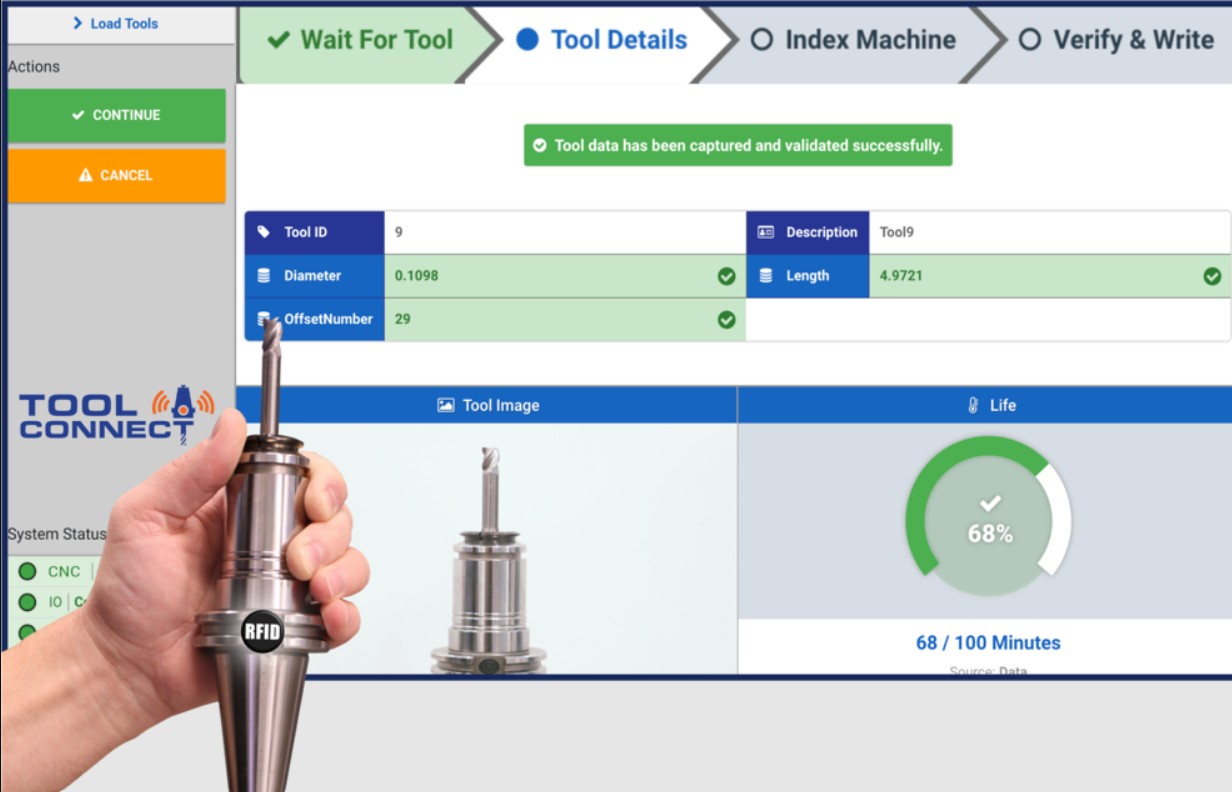
Caron Engineering takes a similar approach with MiConnect, a graphical environment for connecting CNC equipment and software. Its TMAC system uses machine sensors for continuous process monitoring and real-time adjustments. Caron has also collaborated with Datanomix on TMAC AI, bringing AI-supported decision-making directly to machining operations.
AI agents are emerging elsewhere. ProShop ERP’s Chip captures manufacturing knowledge and makes the experience of skilled employees available to others, helping shops preserve expertise that might otherwise disappear when workers leave.
The broader goal is a connected manufacturing environment in which accurate digital twins, sensor data, AI, and operational software continuously reinforce one another. Vericut’s Gene Granata warns that this capability could become a competitive requirement. Large manufacturers may increasingly expect suppliers to provide detailed production and quality data alongside finished components.
For machine shops, producing acceptable parts may therefore no longer be enough. Manufacturers could also need a verifiable digital record explaining exactly how those parts were produced.
