

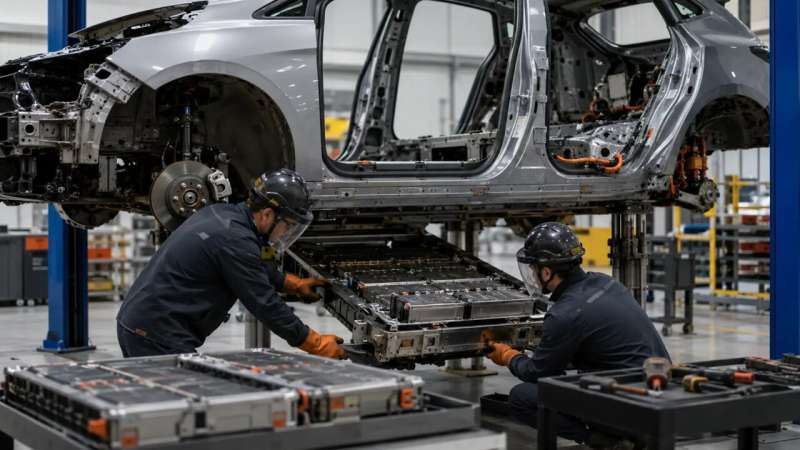
As electric vehicle adoption accelerates worldwide, a growing challenge is emerging: what to do with the massive number of batteries that will eventually reach the end of their automotive service life. A new study highlighted by Tech Xplore argues that artificial intelligence could play a pivotal role in ensuring these batteries do not become a major waste problem but instead remain valuable resources within a circular economy.
The researchers, led by scientists at Sweden’s Chalmers University of Technology, emphasize that many EV batteries retain significant capacity after they are no longer suitable for vehicles. These batteries can often be repurposed for less demanding applications, such as stationary energy storage, before ultimately being recycled. However, determining a battery’s condition, remaining lifespan, and most suitable next use remains a complex task.
The study identifies artificial intelligence as a key tool for solving this challenge. By analyzing large volumes of data generated throughout a battery’s life, AI systems can assess battery health, predict degradation patterns, and recommend whether a battery should be reused, remanufactured, or recycled. Such insights could improve resource efficiency while reducing waste and lowering the demand for newly mined raw materials.
A major obstacle, however, is the fragmented nature of battery data. Information collected during manufacturing, vehicle operation, maintenance, and recycling is often stored in separate systems, making it difficult to build a complete picture of a battery’s history. The researchers argue that creating secure mechanisms for collecting, sharing, and utilizing this data is essential for realizing AI’s full potential in battery management.
The authors advocate integrating AI across the entire battery life cycle, from production and use to reuse, remanufacturing, and recycling. Such an approach could help establish a more sustainable and economically viable battery ecosystem while supporting the continued growth of electric mobility. Rather than focusing solely on developing better batteries, the study suggests that the future of battery sustainability may depend equally on smarter data systems and intelligent decision-making tools.
