

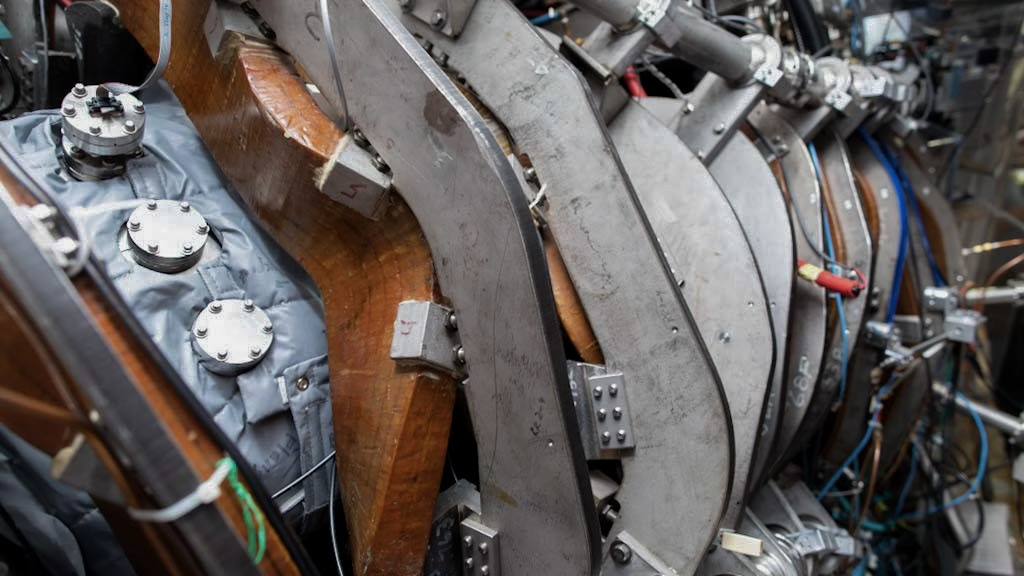
The U.S. Department of Energy has selected Paul Wilson, a professor in the Department of Nuclear Engineering and Engineering Physics at the University of Wisconsin–Madison, to lead a project that aims to accelerate the design of one of the most important components of a future fusion reactor: the breeding blanket. Supported through the DOE’s Genesis Mission Phase I program, the nine-month project will combine artificial intelligence, machine learning, and high-performance computing to improve the speed and quality of fusion reactor design. The award is one of 278 projects chosen nationwide to advance scientific discovery through AI-enabled research workflows, tells University of Wisconsin–Madison.
A breeding blanket surrounds the plasma inside a fusion reactor and performs several essential functions. It captures the high-energy neutrons produced during fusion reactions, converts that energy into usable heat, and generates tritium, the fuel required to sustain future fusion power plants. Designing these blankets is a highly complex task because engineers must balance multiple competing requirements, including neutron performance, heat removal, structural integrity, material durability, and manufacturability.
Wilson’s team plans to address this challenge by developing an AI-assisted optimization framework. The researchers will first generate a large collection of high-fidelity breeding blanket designs using advanced computational simulations. These results will then be used to train machine learning models capable of predicting promising design configurations much more quickly than conventional simulation alone. The approach is expected to reduce the time required to evaluate thousands of potential blanket designs while maintaining engineering accuracy.
The project forms part of the DOE’s broader Genesis Mission, an initiative that seeks to integrate AI with scientific research, supercomputing, quantum technologies, and advanced scientific instruments. At the University of Wisconsin–Madison, five research teams received Genesis Mission awards, covering topics from fusion energy to critical minerals, making the university one of the nation’s leading recipients of the program.
By reducing the time needed to optimize breeding blanket designs, the project could accelerate the development of practical fusion energy systems. Faster design cycles would enable researchers to explore more innovative reactor concepts, improve performance, and move commercial fusion power closer to reality. The work also demonstrates how AI is becoming an increasingly valuable engineering tool, helping scientists solve complex, multidisciplinary problems that would otherwise require years of computational effort.
