

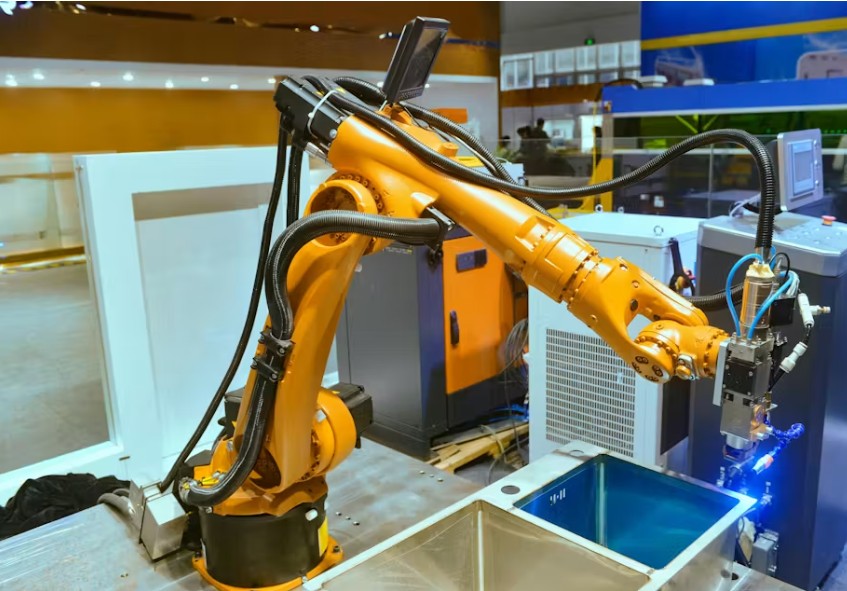
Industry 5.0 represents more than an evolution of connected factories. According to the Machine Design article, it marks a fundamental shift in mechanical engineering, where artificial intelligence becomes an integral part of the physical machines themselves rather than an external software layer. Instead of relying solely on cloud computing and connected sensors, the next generation of industrial systems will embed intelligence directly into mechanical hardware, allowing equipment to predict failures, optimize performance, and adapt to changing operating conditions in real time.
The article argues that traditional control systems, particularly proportional-integral-derivative (PID) controllers, are increasingly inadequate for today’s high-speed manufacturing environments. These systems react only after deviations occur, which can lead to positional errors, accelerated wear, and costly downtime. AI-enabled mechanical systems, by contrast, use predictive models to anticipate problems before they affect performance, improving precision while extending equipment life.
Artificial intelligence is also transforming the product development process. AI-driven generative kinematic synthesis evaluates thousands of potential mechanism designs based on motion, payload, durability, and manufacturability requirements. Digital twins simulate millions of operating cycles to identify wear patterns and degradation long before physical prototypes are built. AI-assisted tolerance analysis further optimizes manufacturing precision while reducing unnecessary material use and production costs. These capabilities allow engineers to deliver mechanical systems that are optimized throughout their operational life cycle rather than only for initial performance.
A key technology highlighted in the article is the use of Physics-Informed Neural Networks (PINNs). Unlike conventional AI models that learn only from data, PINNs incorporate the laws of classical mechanics into their calculations. By combining sensor data with principles such as Newtonian motion and beam theory, these models can distinguish between issues such as thermal expansion, gear backlash, and structural fatigue. This enables machines to adjust motion proactively, maintain tighter tolerances, and support edge-based predictive maintenance that minimizes unplanned downtime.
The article concludes that the future of Industry 5.0 lies in merging software intelligence with mechanical engineering. As AI becomes embedded in machine design, engineers will increasingly develop systems that learn, diagnose, and optimize themselves, creating manufacturing operations that are more resilient, efficient, and sustainable while delivering greater economic value over their lifetime.
