

AI is lowering the barriers to building and customizing software, raising a difficult question for product lifecycle management vendors: What will customers continue paying for when competitors can reproduce features faster? Beyond PLM’s Oleg Shilovitsky argues that PLM will remain essential, but traditional feature-based advantages and software business models face increasing pressure.
AI-generated applications do not need to replicate every capability of mature PLM platforms. They only need enough functionality to solve specific customer problems. Meanwhile, AI agents could replace some work currently performed by users across multiple applications. Yet manufacturers still need authoritative product configurations, revisions, approvals, supplier information, engineering change control, and traceability.
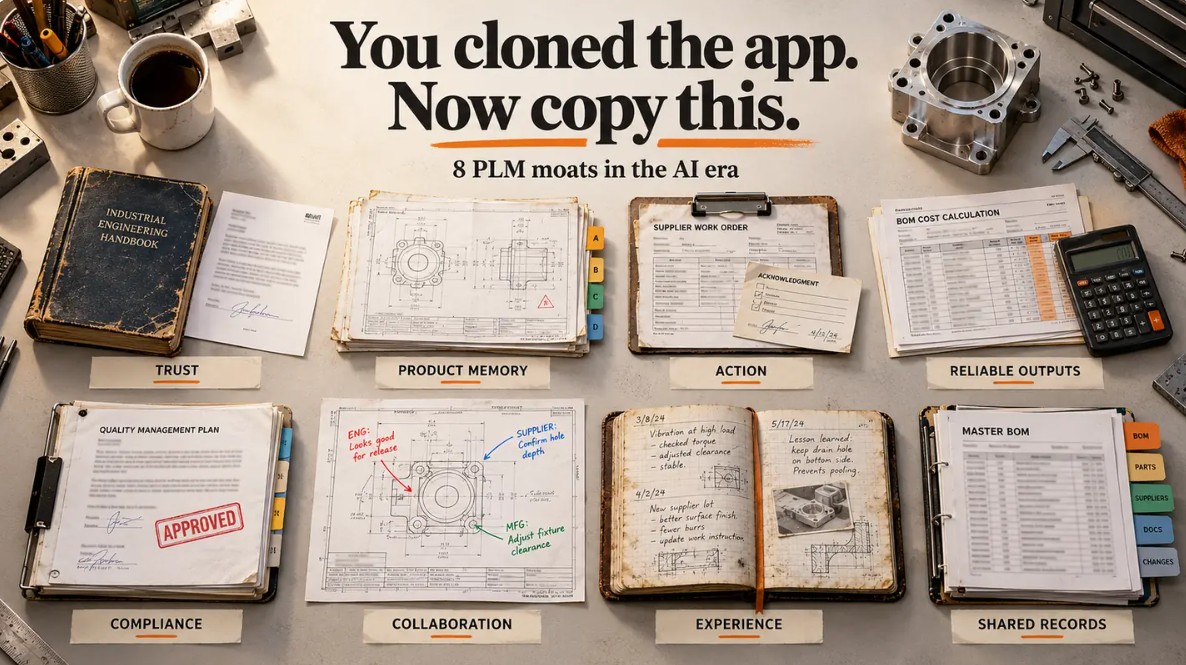
Shilovitsky identifies eight potential moats for PLM vendors. The first is industry trust built through successful implementations, support, expertise, and user communities. Another is maintaining systems of record and Product Memory, which preserves not only product structures and revisions but also decisions, relationships, rejected alternatives, and outcomes.
Other defenses include AI agents trusted to execute defined processes, reliable BOM cost and quantity calculations, and regulatory and compliance capabilities backed by traceable evidence. PLM platforms can also gain value by connecting OEMs, suppliers, contractors, and manufacturers through established collaboration networks.
A particularly important advantage could come from learning across engineering and manufacturing outcomes. By preserving clarification requests, approvals, production feedback, and other historical context, platforms could use previous experience to improve future work. Maintaining current BOM, supplier, component, and service information provides another defensible service that cannot be reproduced simply by copying an interface.
AI may also push PLM companies beyond selling software tools toward completing defined engineering and manufacturing tasks. Shilovitsky concludes that PLM’s future advantage will depend less on code and feature counts and more on what customers trust platforms to maintain, coordinate, execute, and learn from.
