

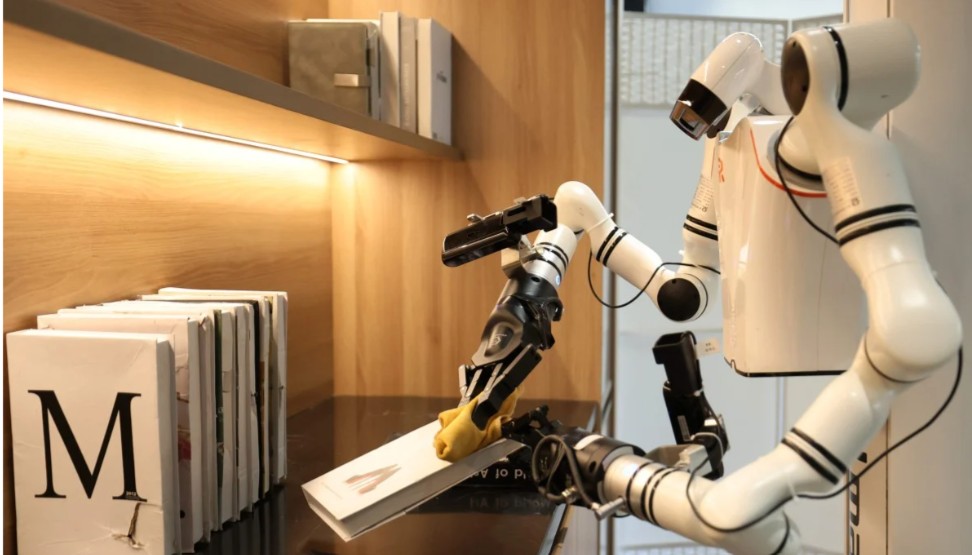
Chinese researchers have unveiled a new approach to training household robots that could significantly reduce one of the biggest challenges in domestic robotics: obtaining enough real-world data. The team claims to have developed a framework that uses AI-generated virtual homes to train robots before deploying them in real environments. The research aims to help robots learn household tasks more efficiently while lowering the cost and time associated with collecting data from physical homes, tells South China Morning Post.
Training robots for domestic settings remains far more challenging than training them for structured industrial environments. Homes differ greatly in layout, furniture arrangements, lighting conditions, and the placement of everyday objects. As a result, gathering sufficient real-world training data is both expensive and time-consuming. The researchers seek to address this problem by creating large numbers of virtual homes generated by artificial intelligence, allowing robots to encounter a wide variety of situations during training.
The framework enables robots to practice navigation, object manipulation, and task execution in simulated environments that mimic real-world conditions. By exposing robots to diverse digital homes, the system helps them develop greater adaptability and improve their ability to function in unfamiliar settings. The goal is to reduce the gap between simulation and reality, a long-standing challenge in robotics research.
The work reflects a broader trend in embodied AI, where physical robots are trained using large-scale simulations before being deployed in the real world. Such methods make it possible to generate training data at a scale that would be difficult or impossible to achieve through physical testing alone.
If validated through further research and real-world deployment, the approach could accelerate the development of consumer robots capable of assisting with daily household activities such as cleaning, organizing, and handling common objects. The research also underscores China’s growing focus on embodied AI and robotics, areas increasingly viewed as important next frontiers in artificial intelligence. By combining AI-generated environments with robotic learning, researchers hope to create more capable and adaptable household assistants for future homes.
