

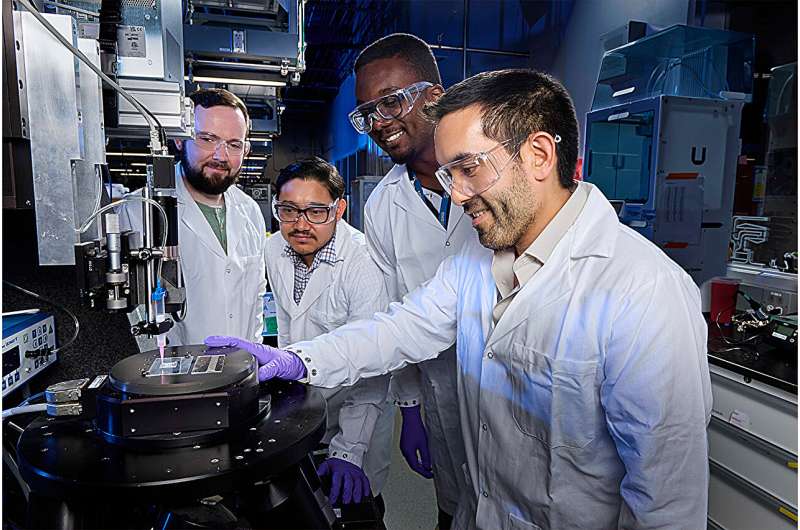
Researchers at Lawrence Livermore National Laboratory have developed an AI-powered inspection system that allows 3D printers to examine parts as they are being manufactured. The approach combines cameras, machine learning, and computer vision to measure deposited material and identify potential defects during direct ink writing, tells Tech Xplore.
Direct ink writing deposits soft or paste-like materials through a nozzle as precisely arranged strands. Small variations in filament diameter, broken strands, or gaps can influence a finished component’s mechanical performance. Traditionally, engineers inspect completed parts using methods such as X-ray computed tomography or mechanical testing. These processes can be expensive and may reveal problems only after manufacturing is complete.
The LLNL system instead captures images as each layer is printed. Machine-learning image segmentation identifies newly deposited strands, while computer vision algorithms trace them and measure characteristics such as filament diameter. The researchers trained their model using nearly 15,000 human-annotated images covering several lattice geometries. Tests on 55 parts showed that automated measurements were typically within a few micrometers of measurements made by humans.
Speed is another major advantage. Manually analyzing a large image can require 20 minutes to an hour, while the automated pipeline performs the task in milliseconds, making it roughly 100,000 times faster on average.
In one demonstration, researchers inspected a cushion measuring approximately 25 × 25 centimeters. About 2,500 images from a single layer were combined into a spatial map. The system detected gradual changes in filament diameter that revealed a slight tilt between the printing platform and nozzle.
Researchers see the technology as a foundation for autonomous manufacturing. Future systems could use inspection data to reject defective parts, guide simulations and digital twins, and eventually allow printers to assess the quality of their own work while production is still underway.
