

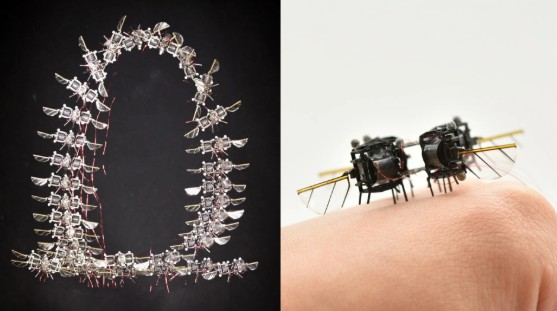
MIT researchers have developed an AI-based control system that enables a tiny flying robot to approach the speed and agility of real insects. The advance could eventually help insect-scale robots navigate confined or dangerous environments, including collapsed buildings where conventional drones cannot operate, tells Science Daily.
The microrobot is about the size of a microcassette and weighs less than a paperclip. Its flapping wings are powered by soft artificial muscles capable of extremely rapid movement. Although previous hardware improvements made the robot more durable and maneuverable, its manually tuned controller limited flight performance.
Researchers addressed this problem with a two-stage control architecture. First, a model-predictive controller uses a mathematical model of the robot’s dynamics to plan demanding maneuvers while accounting for limits on force and torque. Although effective, this approach requires too much computation for rapid real-time control.
The team therefore used imitation learning to train a deep-learning policy on the behavior of the computationally intensive planner. This faster AI model converts information about the robot’s position into real-time commands for thrust and torque, allowing it to execute aggressive maneuvers efficiently.
Tests showed substantial performance gains. The microrobot flew 447% faster than earlier versions and achieved a 255% increase in acceleration. It also completed 10 consecutive somersaults in 11 seconds while remaining within roughly 4–5 centimeters of its intended trajectory, even when exposed to wind disturbances.
Researchers also demonstrated an insect-inspired maneuver called a saccade, involving rapid acceleration followed by abrupt braking. Such movements could eventually support onboard vision and navigation.
The next goal is to equip the robots with cameras and sensors, reducing their dependence on external motion-capture systems. Researchers also plan to study coordinated flight among multiple microrobots, including collision avoidance, bringing autonomous robotic insect swarms closer to practical applications.
