

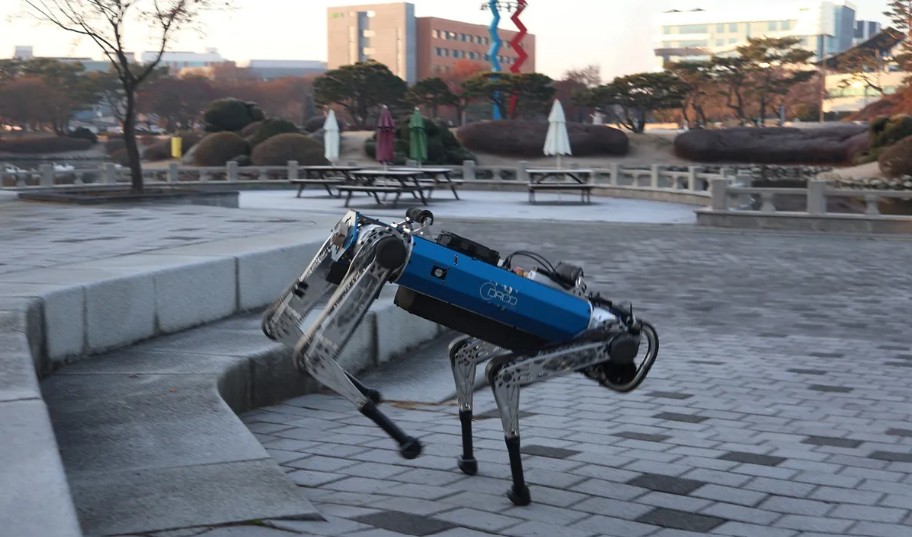
Researchers have developed a new artificial intelligence training method that allows a four-legged robot to traverse complex terrain with greater speed and adaptability. The robot, named KAIST HOUND, can climb stairs, move through forests, and leap over obstacles by autonomously selecting the most suitable gait for the environment. The work, led by researchers at the Korea Advanced Institute of Science and Technology (KAIST), demonstrates how reinforcement learning can help legged robots make rapid movement decisions without human intervention. The findings were published in Science Robotics, tells Live Science.
Weighing about 100 pounds (45 kilograms), KAIST HOUND relies on onboard cameras and lidar sensors to analyze its surroundings. Instead of following fixed movement patterns, the robot continuously evaluates the terrain ahead and switches between a steady trot and a faster bounding gait as conditions change. This ability enables it to negotiate uneven trails, descend staircases, and clear fallen logs while maintaining balance and stability. During testing, the robot reached speeds of up to 9.5 mph (15 km/h), demonstrating both agility and robust locomotion in real-world environments.
The breakthrough stems from a training framework called action pretrained transformer-based reinforcement learning (APT-RL). Researchers first generated more than 180,000 optimized movement sequences to teach the robot a wide range of locomotion skills. Reinforcement learning then refined these behaviors, enabling the robot to determine when and how to transition between different gaits. Unlike conventional systems that rely on rigid, preprogrammed motion modules, APT-RL allows the robot to adapt fluidly to unexpected obstacles and changing terrain using a single decision-making framework.
The researchers believe the technology could expand the role of quadruped robots in disaster response, infrastructure inspection, environmental monitoring, and exploration missions where terrain is unpredictable or hazardous for humans. Although the current system supports only trotting, bounding, and primarily forward movement, future work aims to incorporate additional behaviors such as turning, crawling, and more sophisticated terrain adaptation. The study highlights how advances in AI-driven locomotion are bringing autonomous robots closer to operating reliably in the complex environments encountered outside the laboratory.
