

Researchers at Sandia National Laboratories are developing an artificial intelligence system designed to help electric-grid operators detect cyberattacks and physical problems faster. Called Grid DNA, the technology combines cybersecurity information with physical grid data to identify unusual activity and determine whether a disturbance is digital, physical, or a combination of both, tells Tech Briefs.
The system addresses a difficult monitoring problem. Cyber data may arrive intermittently, while measurements of voltage, current, frequency, and other physical conditions are collected much more frequently. Sandia researchers use data fusion, feature analysis, and carefully selected time windows to bring these different streams together for AI analysis.
At the core of Grid DNA are autoencoder neural networks trained to recognize normal grid behavior. As new information arrives, the AI reconstructs expected signals and compares them with actual measurements. Larger reconstruction errors can indicate anomalies. Examining errors associated with individual cyber and physical features helps the system classify the type of disturbance and provide operators with more useful information.
Grid DNA is also designed as a distributed monitoring system. Local sensors can watch individual components, while multiple sensors within a utility can exchange alerts and determine whether a problem is spreading. At a broader level, utilities and independent energy-system operators could share obfuscated warnings without revealing sensitive raw data or network topology.
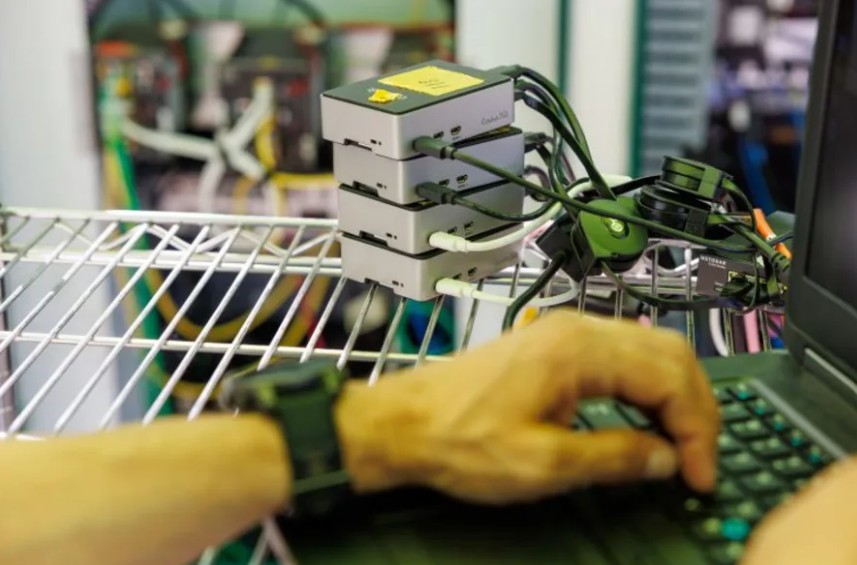
Deployment does not necessarily require expensive new hardware. Sandia has demonstrated the AI on inexpensive single-board computers and developed software containers that could operate on existing grid-security equipment.
The researchers are testing the technology with the Public Service Company of New Mexico to evaluate its performance under real-world conditions. Sandia also sees potential beyond electric grids. By adapting the physical measurements being monitored, similar cyber-physical AI could eventually protect water systems, nuclear facilities, and other critical infrastructure.
