

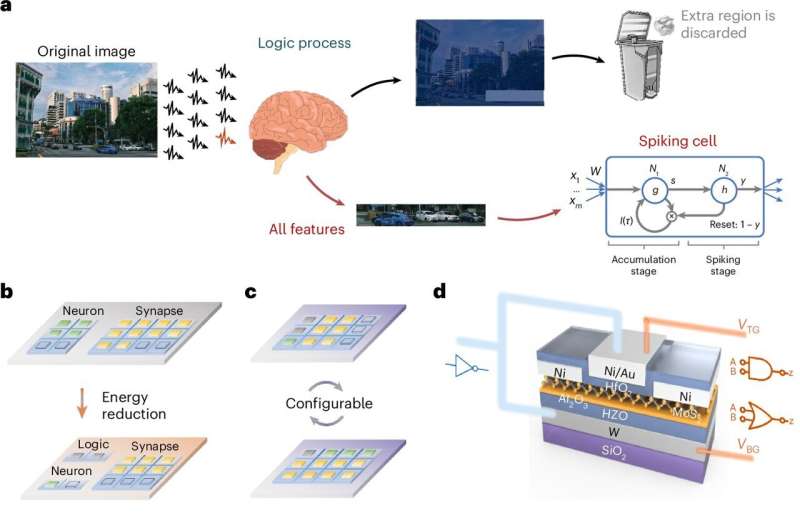
Researchers at the National University of Singapore have developed a transistor that could help AI vision systems save energy by filtering out unnecessary image details before processing begins. The approach could benefit drones, smart cameras, and other devices operating with limited battery power, tells Tech Xplore.
The design combines filtering circuits with a spiking neural network, which processes information through electrical pulses inspired by biological neurons. Control signals specify which image regions should pass through. Only those pixels reach the network, reducing activity caused by irrelevant backgrounds.
Its key component is a reconfigurable transistor made with an atomically thin molybdenum disulfide semiconductor and a ferroelectric hafnium zirconium oxide layer. Different electrical signals let the same device perform logic operations, mimic neurons, or store connection strengths between neurons. Groups of these transistors, called tiles, can switch assignments according to the task.
To evaluate the approach, researchers ran simulations informed by measurements of fabricated transistors. Cropping handwritten digit images from 28 × 28 pixels to 20 × 20 reduced active tiles by about 36%, including the hardware needed for filtering. Stored connection weights fell by almost half, while recognition accuracy slipped just 0.3 percentage points from 95.9%.
More aggressive cropping revealed the tradeoff. At 16 × 16 pixels, useful portions of digits disappeared, lowering accuracy to 94.4%.
A separate traffic scene simulation estimated energy savings of about 59% when selecting a vehicle region and 77% when selecting its license plate. These figures cover computing arrays only, excluding supporting circuitry, and do not establish complete device energy savings.
The team next plans to develop AI accelerator chiplets combining energy management, memory technologies, and optical data connections. Testing realistic workloads will help determine whether the approach can deliver practical improvements in energy efficiency, processing speed, and data movement across future AI systems.
