

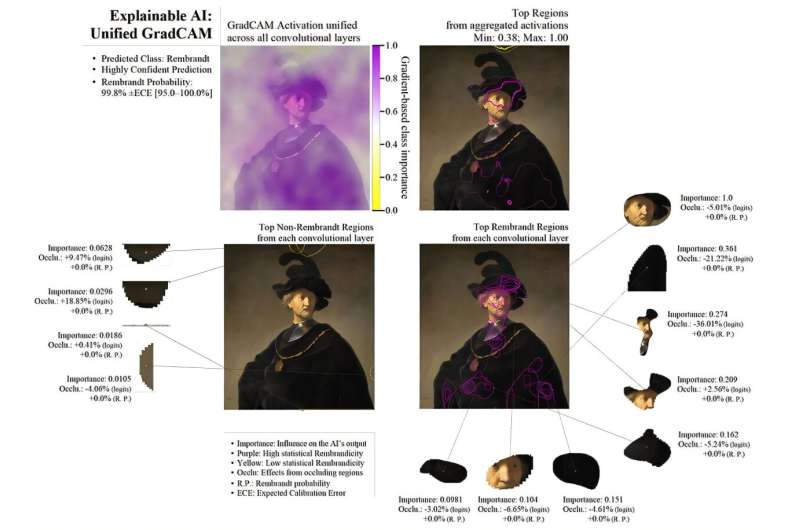
Researchers at Carnegie Mellon University have developed an artificial intelligence framework designed to help art experts investigate whether paintings were created by Rembrandt. Rather than replacing traditional authentication methods, the system provides another source of evidence that can be combined with historical research, material analysis, X-rays, infrared imaging, and expert judgment, tells Tech Xplore.
The interdisciplinary team included mechanical engineering professors Phil LeDuc and Jon Cagan, alumnus Andrés Arias-Rosales, and Rembrandt scholar Arthur Wheelock Jr. Before building the system, the researchers studied Rembrandt paintings at the National Gallery of Art and consulted Wheelock about the artist’s techniques, stylistic variations, and the complexities surrounding attribution.
The researchers assembled more than 1,300 high-resolution digital images, including 311 Rembrandt paintings. Their AI model analyzes statistical patterns involving edges, color, light distribution, and visible brushstrokes. When operating with high confidence, it classified paintings with 95.8% accuracy.
A central feature is explainability. Instead of simply labeling a painting as a Rembrandt or not, the framework provides probabilities, confidence scores, and visualizations showing which parts of an artwork most influenced its conclusion. Experts can then investigate suspicious areas. If the system repeatedly identifies hands as inconsistent with Rembrandt’s work, for example, researchers can exclude that region and reassess the painting. Such analysis could reveal contributions from students, assistants, or later restorers.
The researchers tested the technology on Portrait of a Girl, discovered in a Maine attic in 2024 and later sold for $1.41 million. The model returned an 84.7% confidence score for Rembrandt attribution. The researchers stress that this result is not authentication, but statistical evidence for experts to evaluate alongside other findings.
The team ultimately envisions an interactive tool for museums and curators that could be adapted to investigate works by other artists.
