

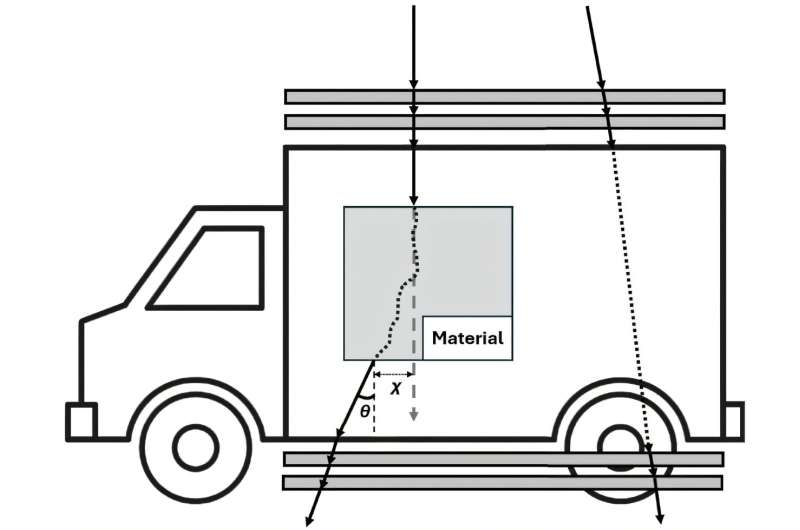
Researchers at the University of Tartu in Estonia, collaborating with technology company GScan, have developed AI-based methods to improve the accuracy of muon tomography, a scanning technique that uses naturally occurring cosmic particles to examine the interiors of large structures without damaging them, tells Tech Xplore.
Muon tomography relies on muons, particles produced when cosmic rays interact with Earth’s atmosphere. Approximately 10,000 muons strike each square meter of Earth’s surface every minute. These particles penetrate thick materials, including concrete, steel, and rock, making them useful for inspecting bridges, buildings, and industrial equipment.
Detectors track muons as they pass through objects. While some travel in straight lines, others scatter when encountering dense materials. Analyzing these trajectories helps researchers identify hidden objects and determine their locations. However, slow particle arrival rates and noisy measurements often produce unclear images.
Led by lecturer Kallol Roy, the research team developed machine learning models that analyze both straight and scattered muon trajectories. Combining these measurements provides more information about where objects are present or absent.
In computer simulations, the approach located hidden objects more accurately than conventional muon imaging methods. A hybrid technique also improved the separation of closely spaced objects, reducing incorrectly merged detections from approximately 15% to 2%.
The researchers are investigating material identification using muon measurements. They have analyzed 14 materials and tested statistical and machine learning techniques to distinguish their properties.
Potential applications include monitoring structural integrity, detecting concealed hazardous materials, and inspecting industrial facilities without destructive testing or artificial X-ray radiation.
However, the technology requires further validation under real-world conditions. Researchers plan to improve model reliability and expand training datasets to accommodate more materials and complex environments.
The research demonstrates AI’s potential to improve nondestructive inspection by extracting more useful information from cosmic particle measurements.
