

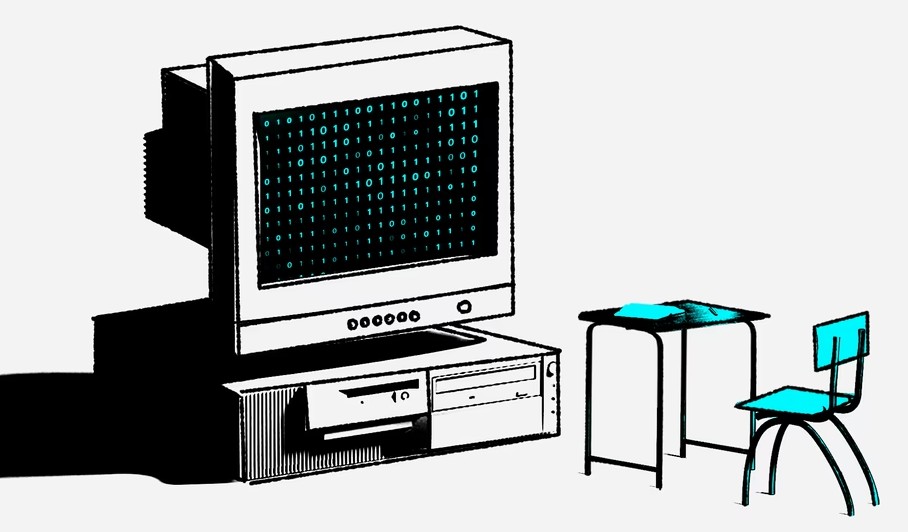
An article from The Atlantic (full article available to subscribers) examines the growing anxiety surrounding computer science education as artificial intelligence systems become increasingly capable of generating code. For years, computer science was viewed as one of the safest and most valuable university majors, offering strong salaries and stable demand. The rapid advancement of AI coding tools is now challenging assumptions about what programming careers may look like in the future.
The article explores how systems capable of writing, debugging, and explaining software are reshaping perceptions of entry-level programming work. Tasks once assigned to junior developers can increasingly be automated or accelerated through AI assistants. This has led some students to question whether traditional coding expertise will remain as economically valuable as it once appeared.
At the same time, universities continue to experience strong interest in computer science programs. The article notes that many educators believe the discipline remains essential because programming is only one component of broader computational thinking. Skills involving systems design, problem-solving, mathematics, logic, architecture, and human–computer interaction are still considered difficult to automate fully.
The discussion also highlights uncertainty within the technology industry itself. AI tools may increase productivity rather than eliminate developers entirely, potentially changing the nature of software work instead of replacing it outright. Some experts argue that programmers who effectively collaborate with AI systems could become even more valuable, while others worry that demand for large numbers of traditional coding roles may decline over time.
Another concern involves education quality. If students rely heavily on AI-generated code during learning, they may struggle to build the foundational understanding necessary for deeper engineering tasks. Universities are therefore debating how to adapt teaching methods in an era where code generation has become widely accessible.
The article frames the moment as a broader transition rather than a simple technological disruption. Computer science is no longer defined solely by manual coding ability but increasingly by the capacity to guide, evaluate, and collaborate with intelligent systems. The profession remains important, yet its identity is rapidly evolving alongside the tools transforming software development itself.
