

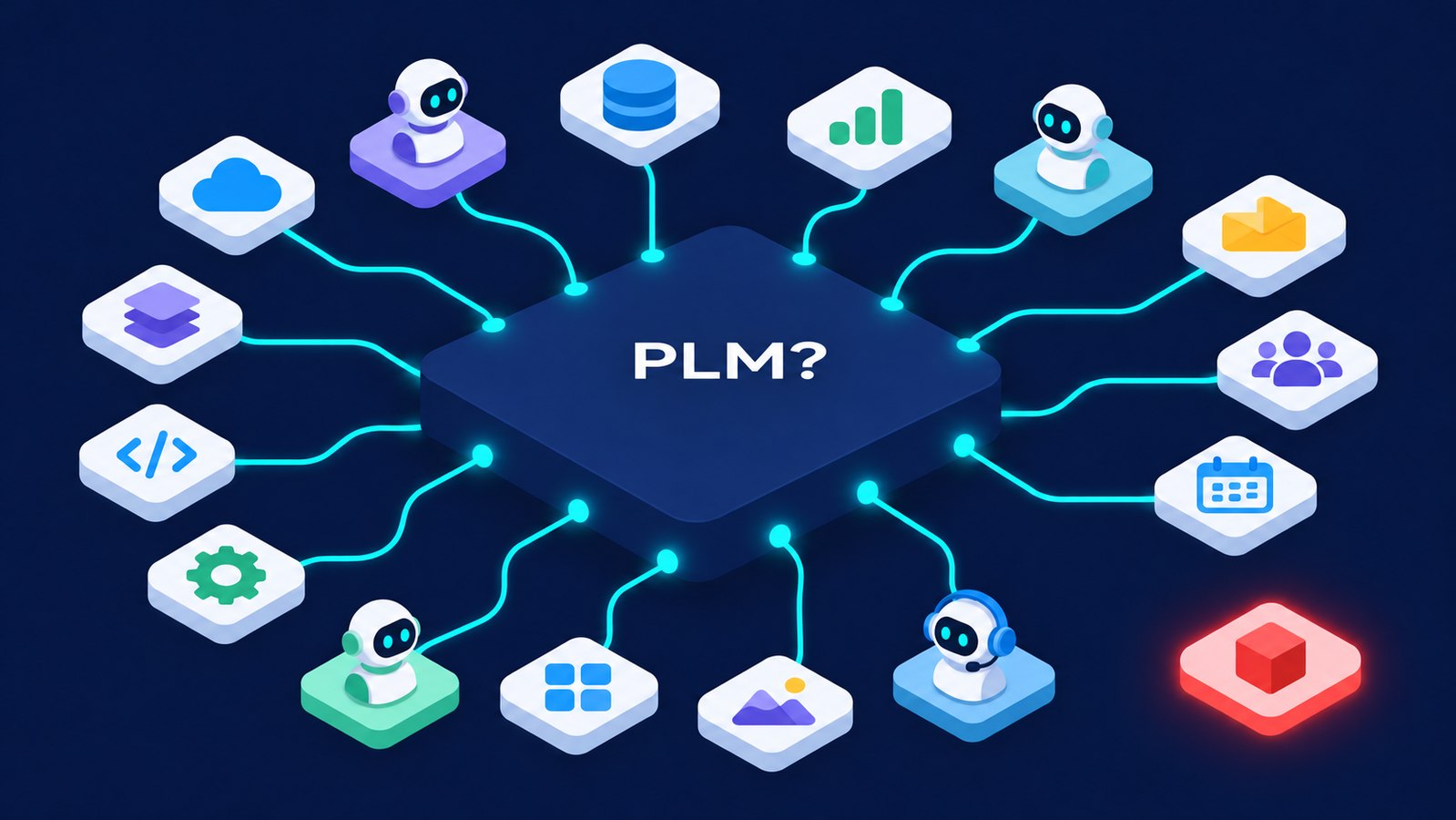
Artificial intelligence is transforming product lifecycle management (PLM) customization by enabling engineers and businesses to develop applications, dashboards, integrations, and AI agents without extensive programming expertise. However, this shift introduces new challenges involving system architecture, governance, and long-term maintenance.
In this Beyond PLM article, Oleg Shilovitsky examines the changing relationship between PLM platforms and customization. Traditionally, vendors discouraged extensive modifications while offering configurable data models, workflows, and development tools. AI is now challenging this approach by dramatically reducing the time and cost of creating software.
Rather than modifying PLM systems internally, organizations can increasingly develop independent applications and AI agents that interact with existing platforms through application programming interfaces (APIs). This makes platform openness essential.
Shilovitsky argues that accessing engineering records alone is insufficient. AI applications also require reliable access to geometric calculations, product configurations, effectivity rules, and permissions. Without these capabilities, developers may recreate critical engineering functions, increasing complexity and potential errors.
A bill of materials (BOM) review application illustrates these challenges. While AI can quickly generate a prototype that identifies missing supplier information, production deployment requires access to revisions, approved manufacturers, inventory, workflows, and business rules.
Maintenance presents another concern. AI-generated applications still require ownership, testing, stable APIs, version control, and compatibility with future platform updates.
PLM vendors must therefore decide whether to support external innovation or restrict development through licensing, technical limitations, and partner requirements.
The article also emphasizes Product Memory, a concept involving connected product information, revision histories, engineering decisions, and relationships. Shared product context could prevent applications from repeatedly reconstructing information through spreadsheets and disconnected databases.
Ultimately, AI may democratize PLM application development, but successful implementation will depend on accessible engineering capabilities, trustworthy product data, effective governance, and platform architectures designed for sustainable customization.
