

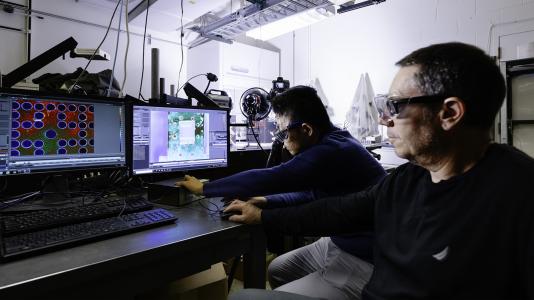
Researchers at the U.S. Department of Energy’s Argonne National Laboratory are developing an artificial intelligence-based monitoring system designed to detect blockages inside heat exchangers used in molten-salt-cooled reactors. The technology could improve reactor reliability by identifying developing faults before they cause equipment damage or unplanned shutdowns.
Molten-salt-cooled reactors operate at substantially higher temperatures than conventional pressurized water reactors. Their salt coolant freezes at about 500°C, or 932°F. If the coolant begins to solidify, it can partially or completely block the thousands of small channels within a heat exchanger, reducing flow and heat-transfer efficiency.
Conventional monitoring typically measures temperature and flow at a heat exchanger’s inlet and outlet. This approach provides limited information about conditions within individual channels. Argonne researchers instead proposed a compact matrix-type heat exchanger equipped with distributed fiber-optic temperature sensing. Sensors mounted on mechanical support structures collect temperature information without penetrating the exchanger’s channels or walls.
AI algorithms analyze the resulting data in real time, searching for subtle temperature patterns that could indicate developing blockages. The system is designed not only to detect a fault but also to identify its location and severity. Explainable AI provides information about why an alarm was triggered, helping operators evaluate and trust the system’s conclusions.
This capability is important because early-stage faults can produce temperature patterns that closely resemble normal operating conditions. AI can continuously examine large volumes of sensor data and identify variations that would be difficult for operators to recognize manually.
Early detection could allow plant operators to plan corrective maintenance before a heat exchanger fails. Because molten-salt-cooled reactors may operate for up to 10 years before refueling, avoiding unnecessary maintenance and unexpected shutdowns could significantly improve operating efficiency. Argonne’s approach demonstrates how intelligent sensing and explainable AI could support safer, more responsive monitoring as advanced reactor technologies move toward commercial deployment.
