

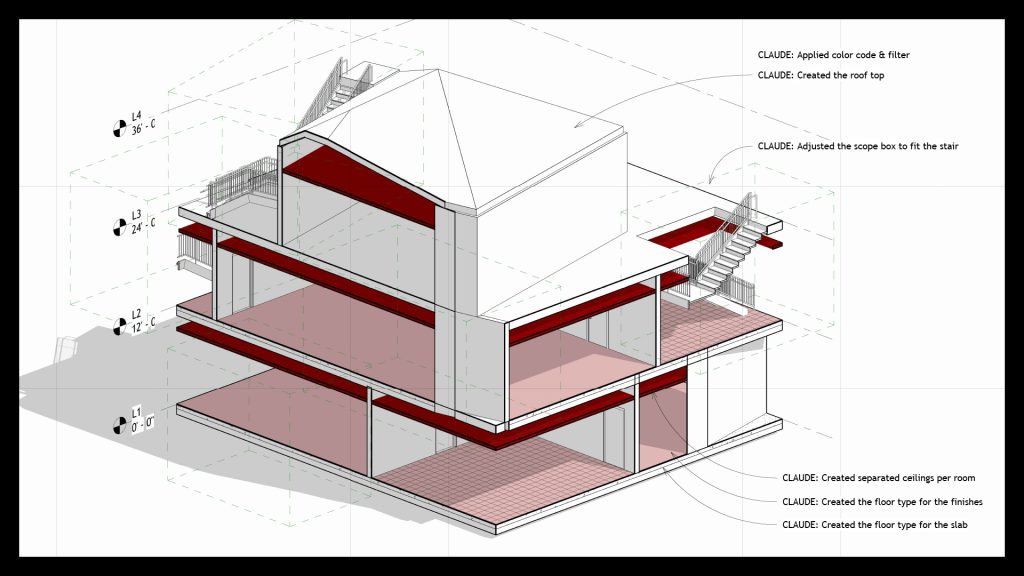
AI tools for Revit typically help with schedules, tags, documentation, or model queries, but architectural designer Chun-Lin Peng wanted to determine whether AI could actually modify and build BIM models. His experiments show that an open-source workflow combining Claude, Model Context Protocol, or MCP, and pyRevit can give AI direct write access to Revit, tells AEC Magazine.
Revit 2027’s Autodesk Assistant can create schedules and tag rooms, doors, and windows, but Peng found that it cannot modify existing model elements. Autodesk’s official MCP server similarly allows AI to retrieve and reorganize model information but remains read-only. This limits AI’s impact on actual modeling work.
Peng’s alternative connects Claude to MCP, which communicates with pyRevit. PyRevit then accesses Revit’s native API. This gives Claude the ability to execute many actions that could otherwise be performed through Python scripts or C# add-ins, while allowing users to initiate tasks using natural-language instructions.
The approach already works for several repetitive production tasks. Peng successfully used it to create walls, windows, ceilings, floor and wall types, filters, worksets, floor plans, and reflected ceiling plans. Ceiling generation proved particularly effective, completing repetitive room-by-room work faster than manual modeling. Reusable AI skills could eventually make such workflows consistent across projects.
More complicated tasks expose current limitations. When asked to reconstruct Mies van der Rohe’s Farnsworth House from 2D drawings, the AI produced a recognizable but unusable model. Stair dimensioning also proved difficult because numerous interdependent parameters must be coordinated correctly. Peng found that breaking complex operations into smaller trained skills produced better results.
The experiment suggests a more consequential role for AI in BIM than simply assisting with documentation. Direct model access could reduce repetitive production work, especially if AI eventually creates families from shop drawings or modifies parameters automatically. The challenge is turning promising demonstrations into reliable, repeatable tools suitable for real project deliverables.
