

Artificial intelligence dominated the digital technology conversation at AIA26, with startups using AI to rethink planning, BIM, code compliance, bidding, and resource management. Architosh’s fifth show-floor report focuses particularly on Germany’s neoBIM and its AI-native approach to AEC software.
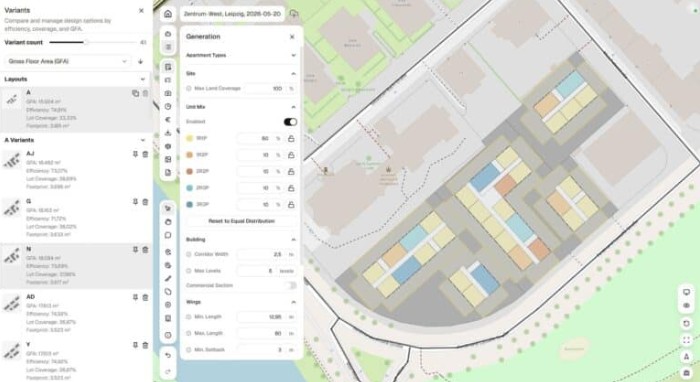
neoBIM, founded by former Enscape co-founder Moritz Luck, is developing buildOS, a collection of tools designed around AI from the beginning. Its Gen application evaluates a building site and generates code-compliant development options. Users can manipulate proposed designs while receiving real-time information on gross floor area, unit mix, development value, yield, costs, and returns. Finished concepts can be exported as Revit or IFC models and PDFs.
Other buildOS tools include Insider, which monitors council meetings, zoning changes, and design competitions across more than 250 German municipalities, and Tender, which manages tendering workflows. More significantly, neoBIM is developing an AI-first BIM authoring application. Instead of relying on the large proprietary databases typical of desktop BIM systems, the platform is being designed around dynamic semantic data that supports machine understanding, real-time collaboration, and agentic AI.
The report also examines Archistar, MeltPlan, and Mosaic. Australia-based Archistar has shifted toward AI-assisted plan review for governments. Its platform reads CAD, PDF, and BIM files and checks them against zoning and building regulations. More than 30 major North American cities use the technology.
MeltPlan applies AI to preconstruction through tools for building-code research, takeoffs, and bid comparison. Its system explains its reasoning and can visualize code-review findings.
Mosaic focuses on workforce planning. Its AI assigns work based on employee skills and availability, automatically adjusts schedules, and forecasts workloads, profitability, revenue, and hiring requirements.
Together, these AIA26 exhibitors illustrate AI’s expanding role across the building lifecycle, from feasibility and BIM authoring to compliance, bidding, and workforce management. The trend points toward increasingly connected, automated, and data-driven AEC workflows.
