

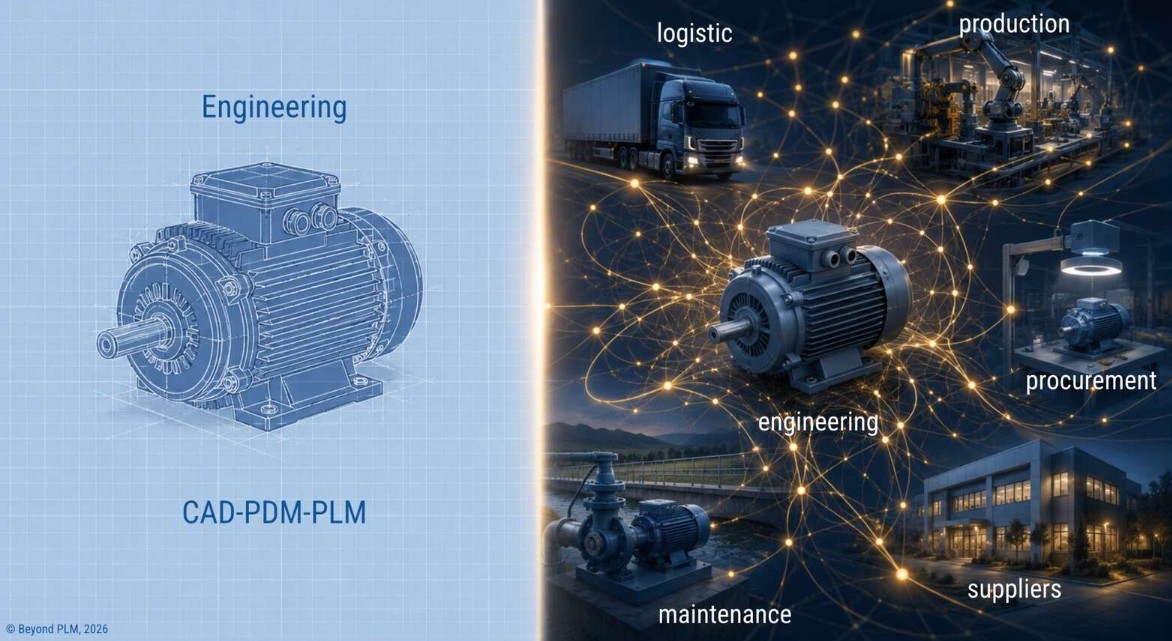
Artificial intelligence can compare components, specifications, and engineering data with impressive accuracy, yet a technically correct answer can still produce the wrong product decision. Beyond PLM argues that reliable AI in engineering requires more than access to product data. It needs an understanding of the complete product situation.
Consider an engineer asking AI whether one motor can replace another. The system might correctly compare power, torque, speed, dimensions, voltage, and mounting interfaces. Yet the recommended motor could violate a customer noise requirement, come from an unapproved supplier, require unavailable factory tooling, affect certification, or repeat an alternative previously rejected after testing.
The article distinguishes between product definition and product situation. Product definition includes CAD models, specifications, bills of materials, requirements, revisions, and configurations traditionally managed through PDM and PLM systems. Product situation extends further, incorporating supplier capacity, inventory, quality holds, manufacturing constraints, installed configurations, service history, and current business conditions.
Simply giving AI access to more documents and databases does not solve the problem. Larger datasets may contain obsolete drawings, conflicting BOMs, expired supplier quotes, multiple revisions, and different definitions of terms such as approved. Effective context must therefore be assembled by determining identity, authority, applicability, configuration, timing, relationships, and missing information.
Beyond PLM identifies three common examples of context failure: retrieving the wrong product revision, recommending a technically compatible but previously rejected substitute, and choosing a cheaper supplier without understanding volume requirements, expired pricing, tooling costs, or quality restrictions. These failures may appear to be AI hallucinations, but the underlying problem can instead be incomplete context architecture.
The article proposes Product Memory as a connected context layer spanning PLM, ERP, MES, QMS, and service systems without replacing them. Such an approach could help AI understand not only what a product is but also its history, operational state, dependencies, and governance.
For engineering organizations, dependable AI will therefore require more than larger models and longer prompts. AI decisions must be traceable, applicable to the correct product situation, and supported by enough context for engineers to review and trust them.
