

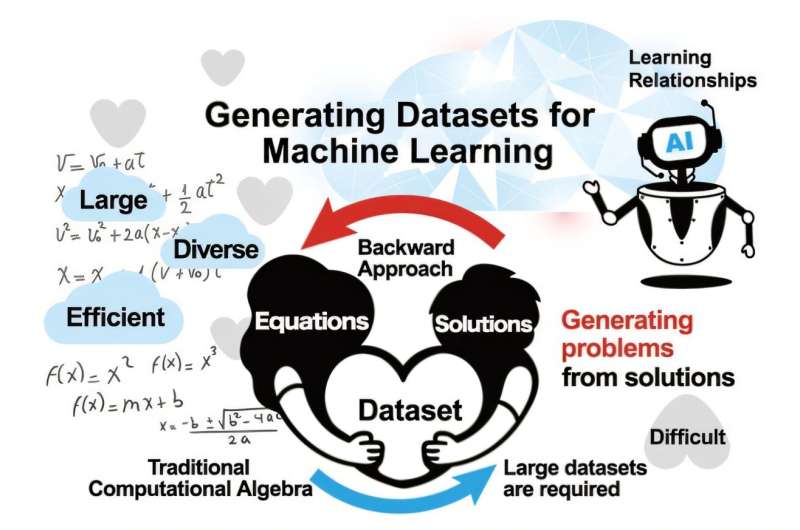
Artificial intelligence is usually applied to mathematics to solve difficult problems. Hiroshi Kera, an associate professor at Chiba University, is exploring the reverse direction: using known solutions to create new mathematical problems. The approach could provide training data for AI while opening new avenues in computational algebra, tells Tech Xplore.
Computational algebra uses algorithms to solve equations, but these calculations can become extremely slow as complexity increases. Even problems involving 5–10 variables can require substantial computation. Kera believes machine learning could complement conventional algorithms by learning relationships between equations and their solutions and developing more efficient strategies for solving them.
Training such AI systems, however, requires large datasets containing mathematical problems paired with solutions. Creating these datasets is difficult. Kera proposes starting with known solutions and working backward to construct corresponding problems. This reverse problem generation could produce diverse training datasets more efficiently than the traditional process of creating a problem first and then calculating its answer.
The approach also gives mathematicians a reason to investigate a direction that previously attracted little attention. According to Kera, some researchers are already finding mathematical insights by looking at problems from this reversed perspective.
Kera’s research draws on experience spanning algebra, genetic algorithms, computer vision, and machine learning. Rather than competing primarily for incremental improvements in AI benchmark performance, he favors research that introduces fundamentally different approaches and combines expertise from multiple disciplines.
Looking ahead, Kera expects AI to become increasingly integrated with computational algebra, potentially creating a field he informally describes as AI Algebra. His group is also developing a software library to make AI more accessible to mathematicians and is participating in a research initiative connecting symbolic computation with machine learning and deep learning. The broader goal is not simply faster mathematics, but new ways for AI and mathematicians to generate questions, explore patterns, and expand mathematical discovery.
