

Researchers at Bristol Robotics Laboratory (BRL), a partnership between the University of Bristol and UWE Bristol, are developing assistive technologies that combine artificial intelligence (AI), robotics, and human-centered engineering to address the challenges of an aging population.
Doctoral researcher Sergio Sierra Marin has helped develop the Socially Assistive Walker (SAW), a prototype that transforms conventional walking frames into intelligent mobility aids. The system integrates sensors, AI, and an interactive virtual companion to support navigation, mobility monitoring, safety, and social engagement.
The walker analyzes users’ movements and provides directional guidance through illuminated indicators and vibrating handles. Automated braking improves safety when users prepare to sit down.
An interactive display provides spoken instructions, visual guidance, and medication reminders. Using a technique called micro-prompting, the system divides everyday activities into manageable steps. A large language model (LLM) also enables brief conversations.
The modular design allows users to retrofit existing walkers with selected features according to individual requirements. Approximately 80 older adults, caregivers, and healthcare professionals contributed to its development. London’s Science Museum plans to exhibit the prototype in its permanent Tomorrow gallery, scheduled to open in 2027.
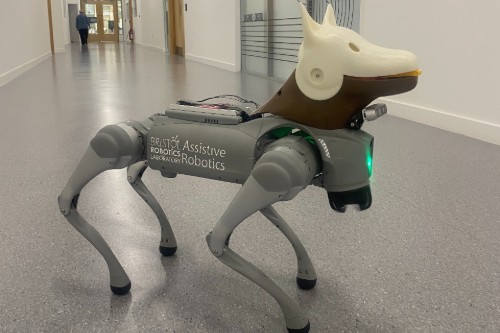
Meanwhile, Sierra Marin and fellow doctoral researcher Ben Allen are collaborating with startup Hijimbo to develop a household assistive robot. The proposed system could locate misplaced belongings, interact with domestic appliances, and notify family members about changes in daily routines. Sierra Marin focuses on AI development, while Allen oversees hardware and mechanical design.
For engineers, these projects illustrate the importance of integrating sensor technologies, intelligent control systems, mechanical engineering, and accessible human–machine interfaces.
Rather than simply automating individual activities, assistive robotics must accommodate changing physical and cognitive needs. The research highlights opportunities to develop personalized technologies that enhance accessibility, promote independent living, and potentially reduce pressure on healthcare and social care services.
