

Fire-rated wall assemblies are essential to building safety, helping contain fire and smoke for specified periods. This Pirros article explains their construction, regulatory requirements, and common design errors while highlighting how AI-powered tools can improve documentation and compliance.
A fire-rated wall consists of framing, gypsum board, fasteners, joints, and insulation tested together to achieve a specific fire-resistance rating. Under the International Building Code (IBC), ratings can be established through standardized testing, approved construction methods, or alternative designs accepted by building officials.
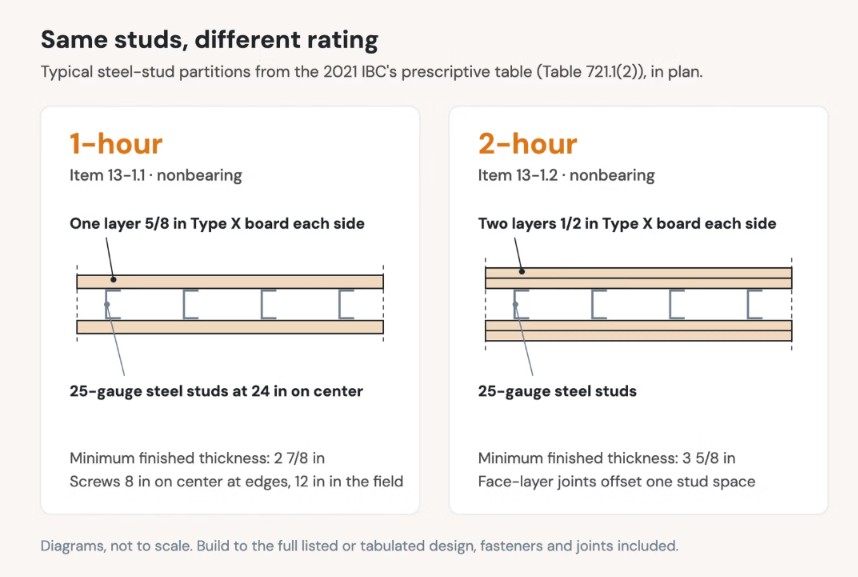
Typical one-hour walls use steel or wood studs covered with a single layer of Type X gypsum board on each side. Two-hour assemblies generally require additional gypsum layers or thicker masonry. Three- and four-hour walls commonly incorporate concrete or masonry construction.
However, achieving the required rating involves more than selecting appropriate materials. Improperly sealed penetrations, inadequate head-of-wall joints, incorrect door ratings, and unauthorized material substitutions can compromise fire resistance.
Accurate architectural documentation is equally important. Designers must maintain consistent wall-type schedules, fire-rating classifications, and construction details across drawing sets. In Autodesk Revit, fire ratings should be assigned to wall-type parameters and reflected accurately in schedules and annotations.
Pirros addresses these challenges through standardized detail management and AI-assisted automation. Its platform helps architectural firms retrieve previously approved construction details, identify duplicates, and maintain consistent design standards across projects.
The company’s Mira AI agent for Revit can automate repetitive modeling tasks. For example, architects can instruct Mira to replace all instances of a particular wall type on a specified floor. The agent identifies affected elements, requests confirmation, and flags potential dimensional changes.
Pirros also offers an AI-powered Quality Management System that checks Revit models and drawing sets against building codes, including the IBC. It identifies potential compliance issues and provides references for human review rather than automatically modifying designs.
Combining standardized construction details with AI-assisted verification can reduce documentation errors, improve efficiency, and support safer building designs.
