

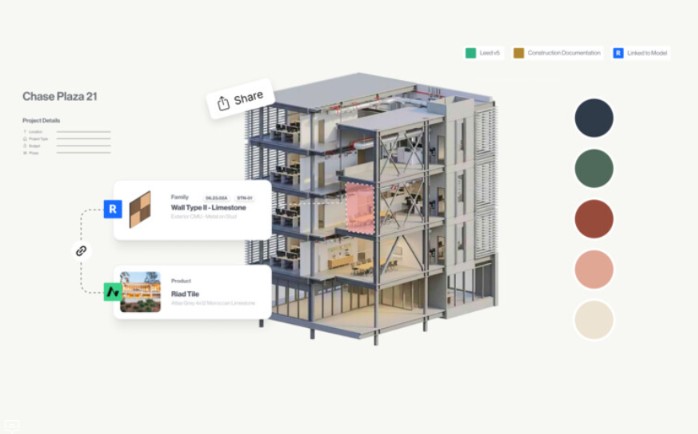
Building information modeling (BIM) has transformed architectural design by connecting drawings, schedules, and three-dimensional models. However, material specifications often remain scattered across spreadsheets, PDFs, manufacturer catalogs, and project documents, creating inconsistencies and costly errors.
In an ArchDaily interview, Dave Lemont, former head of Revit Technology and current executive chairman of Acelab, explains why BIM has yet to achieve the same level of coordination for building materials as it has for geometry.
Lemont advocates a Material Information Model, a structured digital record connecting every material selection to its specifications, drawings, schedules, and related documents. Instead of manually updating multiple files, architects could maintain a single source of information throughout a project’s lifecycle.
Acelab’s Material Hub platform supports this approach by organizing product information into a standardized format. Architects can compare materials based on cost, availability, performance, certifications, building code requirements, and environmental impact. The platform also provides access to health product declarations (HPDs) and environmental product declarations (EPDs).
Artificial intelligence plays an important role through Ace, Acelab’s AI assistant. Ace analyzes product attributes, project requirements, and historical design information to identify inconsistencies, highlight trade-offs, and recommend suitable materials. However, final decisions remain with architects.
The company has also introduced initial integration between Material Hub and Autodesk Revit, enabling synchronization of keynotes and material tags. Future developments aim to connect material selections directly with model elements and assemblies.
Acelab is collaborating with the Innovation Design Consortium to develop an open data schema that would improve interoperability among manufacturers, consultants, and design teams.
For building owners, connected material information could improve cost visibility, compliance monitoring, maintenance, and future renovations. Architects could also reduce documentation errors and evaluate substitutions more effectively.
The broader objective is to extend BIM beyond geometric coordination, making material intelligence an integral part of architectural design and construction.
