

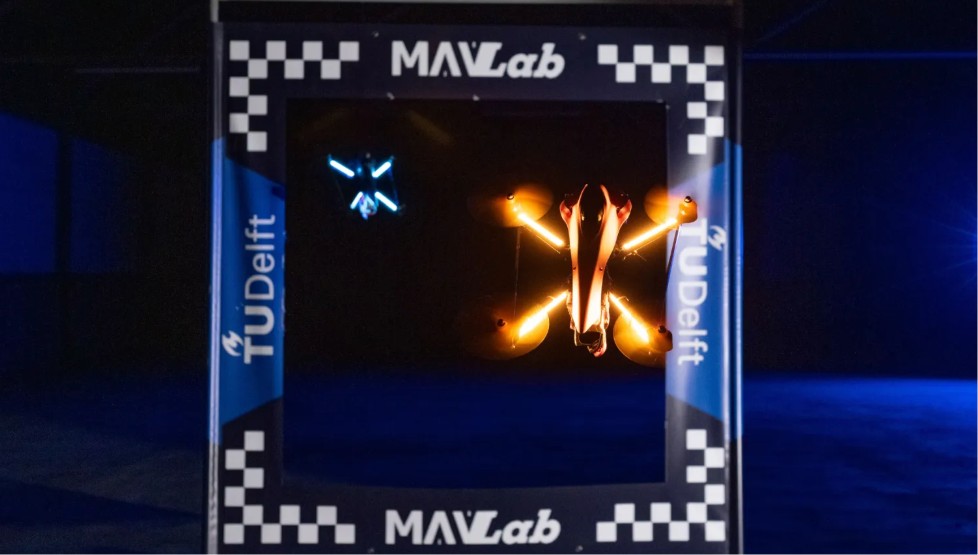
An autonomous racing drone developed by researchers at Delft University of Technology has defeated elite human pilots in an international competition, demonstrating how artificial intelligence can control fast-moving machines in unpredictable real-world environments, tells Popular Science.
The quadcopter, called MonoRace, competed in the Abu Dhabi Autonomous Racing League in November 2025. It defeated every other AI racing team and recorded a faster time than three former human world champions. Researchers say the achievement marks the first time an AI-controlled drone has beaten human pilots in an international racing competition.
MonoRace relies on relatively limited onboard hardware. A forward-facing camera provides visual information, while an inertial measurement unit tracks acceleration and rotation. The AI combines these inputs to determine the drone’s position and movement, allowing it to navigate without GPS. This approach also helps compensate for blurred or distorted camera images produced during high-speed flight.
The drone’s neural network runs on a small onboard computer and issues roughly 500 control commands per second. Instead of following a predetermined flight path, MonoRace directly controls its motors. Researchers trained the system through reinforcement learning, allowing it to learn navigation strategies through repeated trial and error in simulation before transferring those skills to physical flight.
This adaptability distinguishes MonoRace from earlier autonomous racing systems. The University of Zurich’s Swift AI previously defeated human champions in laboratory conditions, but its performance could deteriorate when environmental factors such as lighting changed. MonoRace was designed to operate more reliably outside tightly controlled settings.
During the Abu Dhabi competition, the drone reached approximately 62 mph while navigating gates, loops, and dives. Beyond racing, the research illustrates a broader challenge in physical AI: enabling intelligent machines to perceive their surroundings, make rapid decisions, and control their movements with limited computing resources. Such capabilities could eventually benefit autonomous vehicles, robots, and other machines operating in complex environments.
