

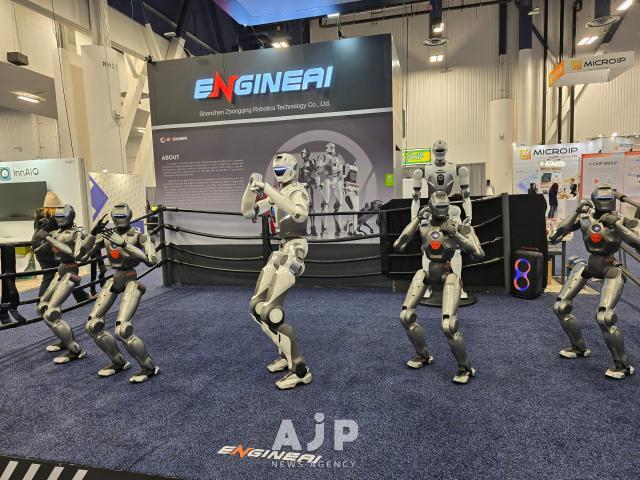
At CES 2026 in Las Vegas, the world’s largest technology expo has become a frontline for competition in physical artificial intelligence, with companies from China, the United States, and South Korea showcasing divergent strategies for the next generation of robots. Rather than just prototypes, this year’s exhibits emphasize manufacturing at scale, deployment in factories and homes, and practical applications of autonomous machines, reports AJU Press.
Chinese firms arrived with striking numbers and ambitious production goals. Roughly one in four robotics exhibitors at the show comes from China, and more than half of the humanoid robot exhibitors are Chinese. Shenzhen-based Engine AI displayed its T800 humanoid model, signaling China’s advantage in mass production. Patents and output figures highlight the scale of China’s push: thousands of entries in humanoid robotics patents and plans to ramp annual production into the thousands.
American companies are taking a different tack, focusing less on humanoid aesthetics and more on specialized functions. Products on display included robots tailored to specific tasks, from a robotic barista to autonomous lawnmowers, designed for immediate commercial use rather than general physical mimicry. Another U.S. exhibitor, Realbotix, showed humanoids geared toward customer service and companionship, already operating in hotels and senior care settings.
South Korea’s approach blends integration, platforms, and ecosystems. Hyundai Motor Group highlighted a next-generation humanoid developed with Boston Dynamics, ready for industrial deployment with tasks such as parts sequencing and assembly in U.S. factories. LG Electronics demonstrated CLOiD, a home-assistant robot capable of everyday chores, embodying a vision of consumer robotics designed for real household use.
These three philosophies, China’s scale first, the United States’s function-focused designs, and Korea’s platform integration, reflect broader industrial priorities and point to a rapidly approaching era where robots will do work once confined to human hands. The competition extends far beyond the CES floor, with implications for manufacturing, labor, and daily life as autonomous machines become accustomed to human environments.
