

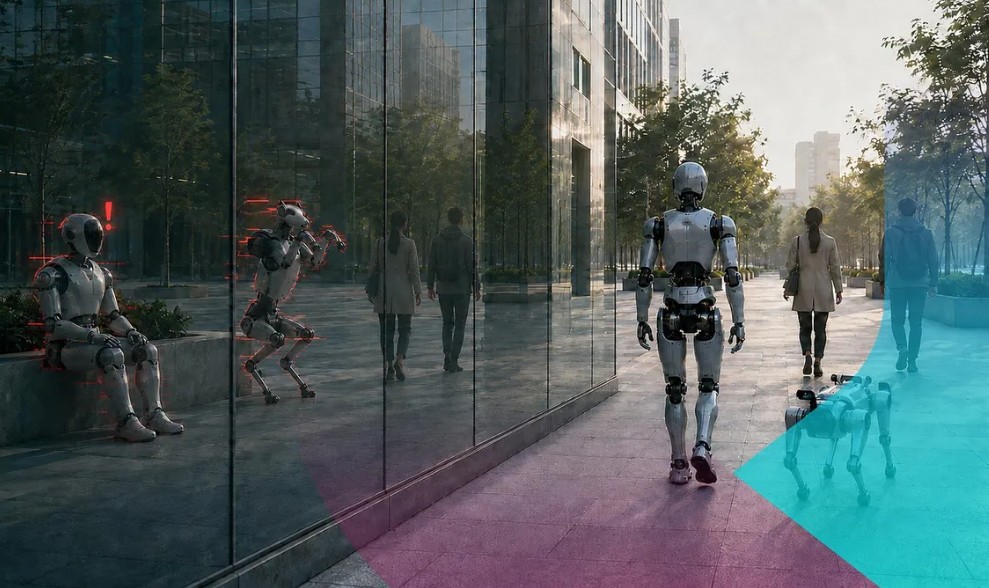
As AI-powered robots move into factories and other real-world environments, safety is no longer limited to preventing mechanical or software failures. Cyberattacks can manipulate what a robot perceives, decides, or does while leaving its underlying systems apparently operational.
The IEEE Spectrum article identifies three layers of vulnerability. The first involves compromising AI models themselves. Research on backdoor attacks shows that hidden triggers can cause models to behave incorrectly only under specific conditions. A 2025 attack called BadVLA demonstrated this risk in vision-language-action models, altering robot movement when a trigger appeared. Another study, GoBA, showed that ordinary objects could become triggers while the AI continued performing normally under clean conditions.
The second risk comes from the broader software and communications infrastructure. Even a secure AI model can be compromised through vulnerable networks, middleware, or robot operating systems. The UniPwn exploit disclosed in 2025 demonstrated how weaknesses in Bluetooth security could enable root-level access to robots and potentially spread across a fleet. Vulnerabilities in ROS 2 and DDS-based systems can similarly expose robots to malicious commands or modified AI model weights.
A third threat targets perception and reasoning during operation. Research has shown that malicious prompts, adversarial images, and visual patches can redirect robots, reduce task performance, or freeze decision-making. In some experiments, a robot could verbally reject an unsafe instruction while its motion controller still carried it out.
These risks suggest that conventional functional safety alone is insufficient for physical AI. The article advocates lifecycle cybersecurity that begins during design and continues through deployment and operation. This includes scanning AI models and software for vulnerabilities, testing attacks in simulation, monitoring behavior continuously, and assessing whether cyber events are affecting physical actions.
The central challenge is ensuring that robots remain within defined safety boundaries even when their perception, reasoning, or control systems are deliberately manipulated.
