

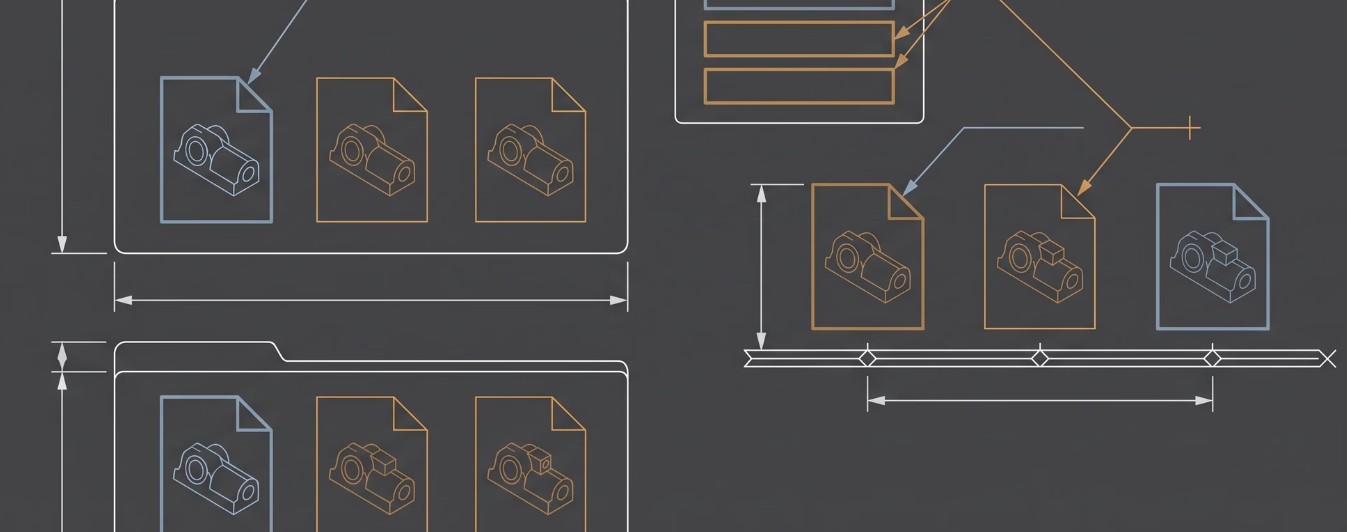
Many engineering teams without product data management software still have an organizational system. Their CAD files typically reside on shared network drives arranged by project, customer, or product. Leo argues that AI indexing can make these informal systems easier to search without requiring companies to implement PDM first.
An indexing agent can extract information from three main sources: filenames and folder paths, file-system metadata such as modification dates and file sizes, and custom properties embedded in CAD files. These properties may contain part numbers, materials, descriptions, revisions, and engineer information. Some CAD platforms also provide APIs that allow such metadata to be extracted without opening the full CAD application.
Revision management presents a greater challenge. Teams without PDM often communicate revisions through filenames containing markers such as version numbers or revision letters, or by separating released and work-in-progress files into different folders. AI can interpret these patterns, but inconsistent naming can make determining the latest version difficult. Moving or renaming files manually can also break references between parts and assemblies.
Leo emphasizes that indexing does not replace PDM governance. An AI agent cannot create check-in and check-out controls, enforce lifecycle states, or guarantee bill-of-materials and where-used traceability when those systems do not already exist. It can instead identify likely current files, detect potential revision conflicts, and improve part discovery.
Leo’s desktop application addresses this problem by monitoring local and mapped network folders. It indexes folder structures, file metadata, and embedded CAD properties as files change, enabling engineers to search their existing design libraries using natural language.
For engineering teams, the approach offers a middle ground between unmanaged folders and full PDM deployment. AI can improve access to existing engineering knowledge immediately, while formal PDM can be introduced later when stronger revision control, lifecycle management, and traceability become necessary.
