

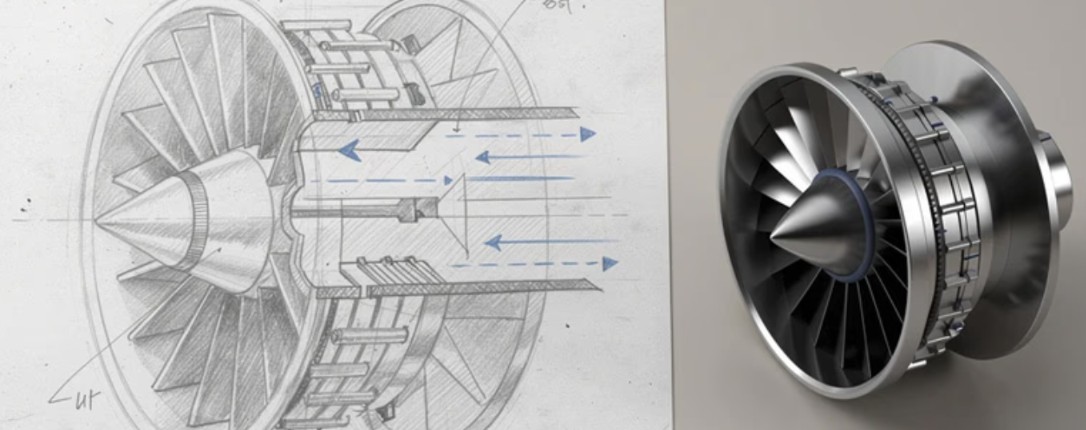
Converting hand-drawn sketches and 2D engineering drawings into accurate 3D CAD models remains challenging despite advances in artificial intelligence (AI). While emerging tools promise faster modeling, many struggle to meet the precision, editability, and manufacturing requirements of professional engineering workflows.
This Leo AI article evaluates five tools: Leo AI, Zoo.dev, CADScribe, Tripo AI, and AdamCAD. The comparison highlights differences between generating visually convincing 3D geometry and creating models suitable for engineering applications.
The article references an August 2025 evaluation by Xometry involving seven text-to-CAD tools. Although some generated acceptable simple components, most struggled with moderately complex parts, including a 24-tooth gear. More demanding designs, such as manifold blocks containing internal channels, produced inaccurate or incomplete results.
A major limitation involves dimensional accuracy. AI-generated models frequently lack precise tolerances, parametric features, and editable design histories. Many systems also produce mesh-based geometry rather than boundary-representation (B-rep) models, restricting their usefulness in conventional CAD workflows.
Among the evaluated tools, Zoo.dev generates B-rep geometry and STEP files, while CADScribe supports STEP and STL exports. AdamCAD produces STL and SCAD files, primarily for simpler designs. Tripo AI focuses on mesh generation for animation, gaming, and visualization rather than manufacturing.
Leo AI takes a different approach by combining 3D concept generation with engineering knowledge management. According to the company, its platform generates mesh concepts from sketches and specifications in under 50 seconds. It also supports engineering documentation, technical calculations, and searches across product lifecycle management (PLM) databases.
The article emphasizes that successful AI-assisted CAD workflows require more than automated geometry creation. Engineers must consider dimensional constraints, material specifications, manufacturing processes, and existing design information.
Although AI can accelerate early conceptualization, conventional CAD software and engineering expertise remain essential for producing accurate, editable, and manufacturable designs.
