

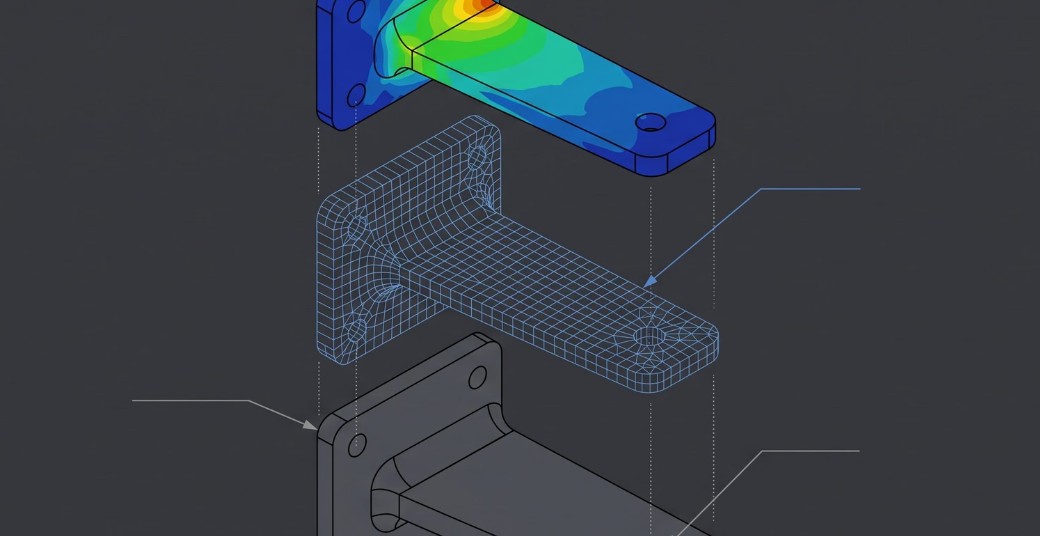
Engineers looking for AI tools for Ansys simulation face three distinct categories rather than one universal solution. Leo AI divides the options into AI embedded within Ansys products, surrogate models that accelerate repeated simulations, and engineering assistants that work alongside the solver. Choosing among them depends on where engineers spend the most time.
Built-in Ansys AI focuses on reducing friction during model preparation and analysis. Ansys GeomAI supports generative concept exploration, while Mesh Agent in Ansys Mechanical helps diagnose meshing failures. Discovery Validation Agent identifies potential setup problems, and Ansys Engineering Copilot provides AI-guided assistance within several products. Some capabilities remain exploratory or in early evaluation, making availability an important consideration.
Surrogate modeling addresses a different bottleneck. Ansys SimAI learns from previously solved simulations and predicts results for new design variations much faster than repeatedly running the full solver. This approach suits recurring families of brackets, housings, heat sinks, and flow components. However, teams must first generate representative training simulations, and predictions outside that design space require additional scrutiny.
The third category includes assistants such as Leo AI that operate beside the solver. Instead of running simulations, these systems help engineers locate specifications, standards, previous analyses, material properties, and design requirements. They can also support calculations and documentation. Leo connects with engineering information stored across PDM, PLM, and enterprise systems and provides citations so engineers can verify its answers.
The article recommends evaluating AI based on workflow bottlenecks rather than product names. Embedded AI suits setup and meshing problems, surrogate models accelerate repetitive simulation families, and engineering assistants address knowledge retrieval and interpretation. Teams should test tools against trusted analyses, examine data security and source traceability, and retain human sign-off. AI may shorten simulation workflows, but engineering accountability remains with the engineer.
