

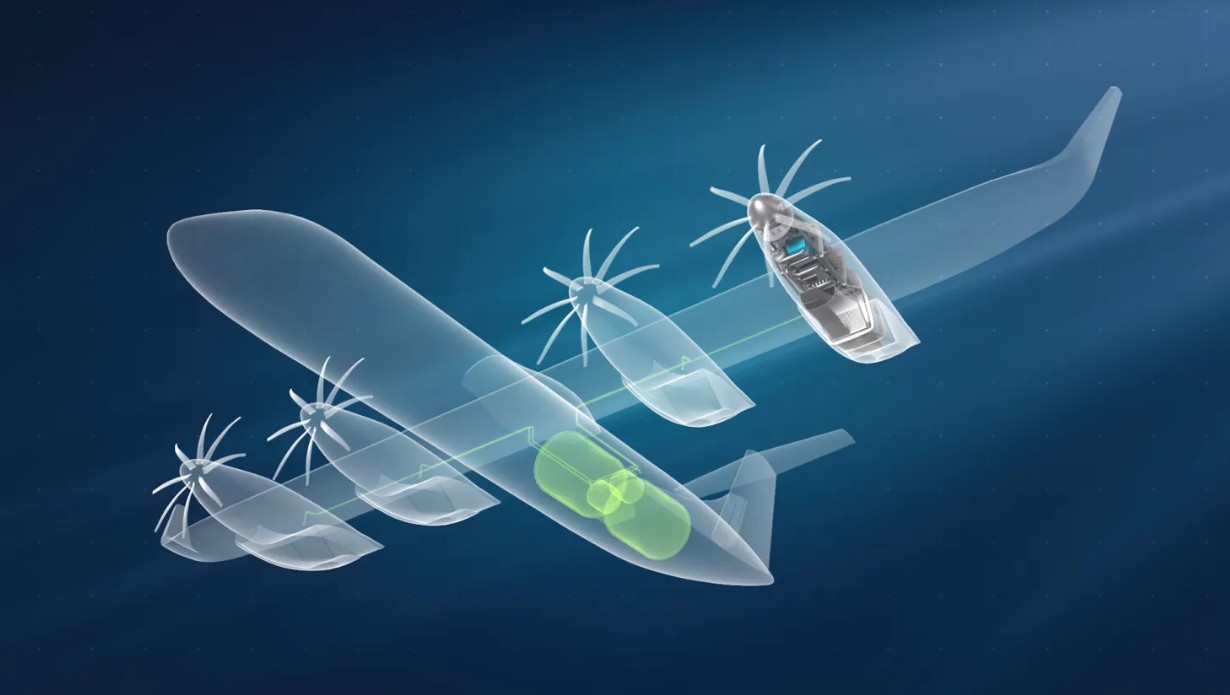
Airbus is taking a major step toward transforming commercial aviation by partnering with Germany’s MTU Aero Engines to develop what the companies describe as the world’s first fully electric hydrogen fuel cell engine for passenger aircraft. Announced as part of Airbus’ ZEROe initiative, the collaboration marks the company’s first direct move into aircraft engine development and reflects a broader effort to reduce aviation’s environmental impact. If regulatory approvals are secured, the joint venture is expected to begin operations in 2027, with the long-term goal of introducing hydrogen-powered commercial aircraft by 2035, tells Popular Science.
Unlike conventional jet engines that burn aviation fuel, the proposed propulsion system relies on hydrogen fuel cells. In this process, liquid hydrogen reacts electrochemically with oxygen to generate electricity, which powers electric motors driving the aircraft’s propellers or fans. Because the reaction does not involve combustion, the primary byproduct is water vapor, eliminating in-flight carbon dioxide emissions and greatly reducing nitrogen oxide emissions associated with traditional jet engines.
The project builds on years of hydrogen research conducted under Airbus’ ZEROe program, launched in 2020. Airbus and MTU signed an initial memorandum of understanding at the 2025 Paris Air Show before deciding to establish a dedicated company focused on designing, testing, certifying, and commercializing the new propulsion technology. Airbus contributes expertise in aircraft integration, liquid hydrogen storage, and fuel cell systems, while MTU brings decades of experience in engine design, certification, and maintenance.
Despite its promise, hydrogen aviation still faces substantial engineering challenges. Liquid hydrogen must be stored at approximately -253°C, requiring advanced cryogenic tanks and specialized airport infrastructure. New safety standards, certification processes, and global fueling networks must also be developed before the technology can be deployed at scale. Airbus and MTU acknowledge that creating this supporting ecosystem is just as important as building the engine itself.
The initiative represents one of the aviation industry’s boldest attempts to achieve climate-neutral flight. While commercial deployment remains nearly a decade away, the partnership signals growing confidence that hydrogen fuel cell propulsion could become a practical alternative to conventional jet engines, helping the aviation sector significantly reduce its carbon footprint while reshaping the future of air travel.
