

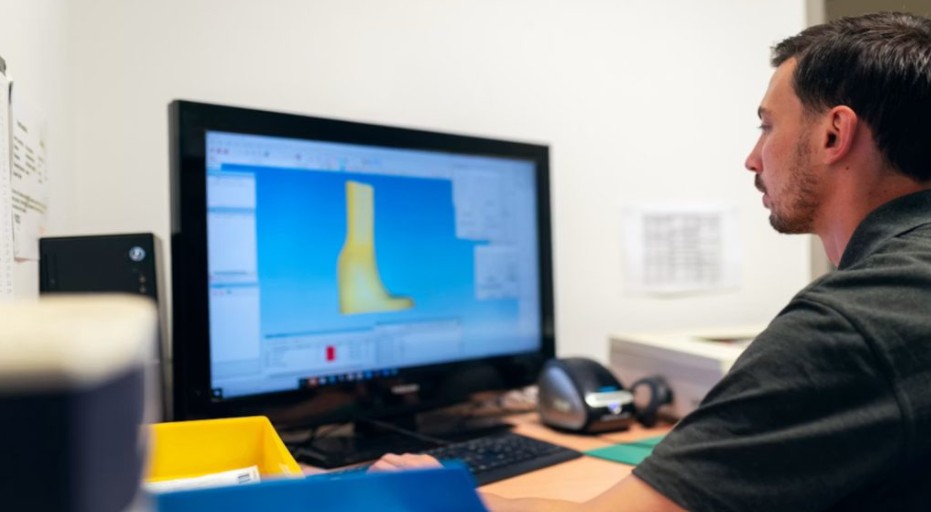
Artificial intelligence has generated enormous excitement across engineering software, but its impact on computer-aided engineering (CAE) remains limited in day-to-day practice. According to the Develop 3D article, AI has yet to fundamentally transform simulation workflows, many of which have changed surprisingly little over the past three decades despite major advances in computing power and software capabilities. Rather than replacing traditional simulation methods, AI’s greatest opportunity lies in reshaping the engineering workflow itself.
The author notes that AI has created unexpected challenges for simulation teams. The rapid expansion of AI infrastructure has increased demand for high-performance hardware, driving up the cost and reducing the availability of memory and solid-state storage used in engineering workstations and compute clusters. These supply chain pressures have made some simulation hardware more expensive, offsetting gains achieved through lower computing costs over recent years.
The article argues that current marketing around AI-powered simulation often overstates its capabilities. While AI models can rapidly predict results after being trained on extensive datasets, they are not universal replacements for conventional finite element analysis (FEA) or computational fluid dynamics (CFD). Developing accurate surrogate models requires significant upfront computational effort, making them best suited for exploring design variations rather than solving entirely new engineering problems from scratch. Traditional physics-based simulation continues to provide the most dependable results for one-off analyses.
Where AI shows genuine promise is in managing the growing complexity of engineering data. It can rapidly search vast simulation datasets, identify meaningful relationships between input parameters and performance, and generate near-instant predictions for intermediate design conditions. This capability could significantly accelerate design optimization, allowing engineers to evaluate more alternatives without repeatedly running computationally intensive simulations.
The article also highlights companies including PhysicsX, Neural Concept, and Luminary Cloud, which are developing AI-driven engineering platforms that combine machine learning with established simulation techniques. These technologies aim to shorten design cycles while preserving the accuracy engineers expect from physics-based analysis.
The author concludes that AI’s future in CAE will not be defined by replacing simulation software but by modernizing engineering workflows that have remained largely unchanged for decades. As AI matures, its greatest contribution may be enabling engineers to explore larger design spaces, automate repetitive tasks, and extract deeper insights from simulation data while leaving core physics calculations to proven numerical methods.
