

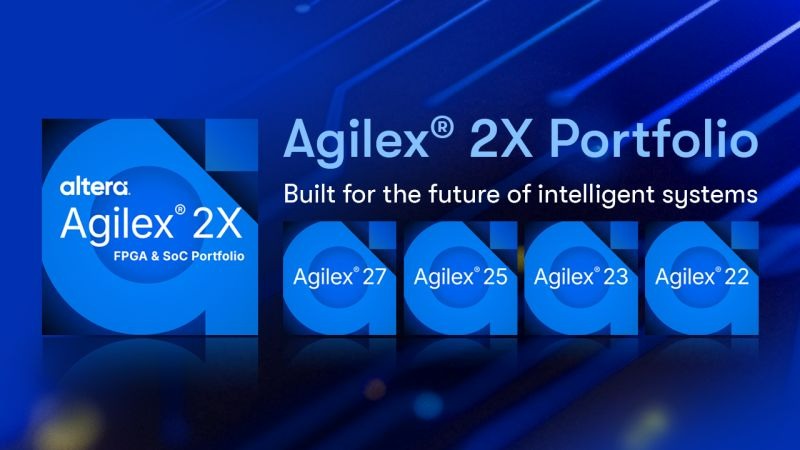
SAN JOSE, CA, Oct 30, 2026 – Altera has introduced Agilex 2X, a four-family FPGA portfolio spanning Digital AI infrastructure and edge systems. Its first family, Agilex 27, targets processing- and bandwidth-intensive applications, with samples expected in the second half of 2027.
“Digital AI and Physical AI are expanding the opportunity for programmable logic uses, as developers build systems that must adapt to rapidly evolving workloads, technologies, and standards,” said Raghib Hussain, president and CEO of Altera. “Agilex 2X is designed to give customers one platform that delivers the performance and density the most complex Digital AI and aerospace and defense systems demand, and scales down to the low power and small footprint the intelligent edge requires. With QuartusIQ support, that scalable foundation protects their engineering investments and aims to get new designs to market faster.”
Four Device Families
The portfolio spans high-performance, midrange, and power- and cost-optimized devices. It includes AI tensor DSP blocks for signal processing, Arm cores for embedded processing, and connectivity supporting current and next-generation standards.
Its four families address different processing, power and I/O requirements:
- Agilex 27: High-performance fabric, high capacity, high memory bandwidth and next-generation connectivity for datapath processing, beamforming and RF processing.
- Agilex 25: High-performance fabric and embedded computing, with optimized I/O, transceivers and peripherals for 4K/8K video processing, drones and low-latency sensors.
- Agilex 23: Embedded computing, real-time processing and functional safety for robotics, industrial automation and automotive systems.
- Agilex 22: High I/O density for board and rack control, motor control, root-of-trust and interface-bridging applications.
All four families will use Quartus Prime design workflows and reusable IP, with the QuartusIQ AI expert companion supporting an agentic design flow. Shared security and embedded software foundations include Arm-based hard processors, Nios V soft processors, post-quantum-cryptography-ready secure boot and functional-safety practices.
Agilex 27 Architecture and Connectivity
Agilex 27 applications include AI infrastructure, terabit networking, 6G and satellite networks, and aerospace and defense systems.
The family uses third-generation HyperFlex fabric. Altera reports a 1.8-fold generation-over-generation improvement in performance per watt compared with Agilex 7. HyperFlex embeds registers throughout the routing fabric, allowing Quartus Prime to retime and pipeline designs without consuming logic resources. New adaptive logic module (ALM) modes also improve logic packing and performance.
Altera’s new HyperFlow data network provides multiterabit-per-second data movement throughout the FPGA without consuming soft logic resources or introducing routing congestion.
Agilex 27 connectivity includes:
- Configurable transceivers supporting speeds up to 256 Gbps.
- Hardened IP for 800GbE and 1.6TbE Ethernet, and PCIe 6.0 and 7.0.
- DDR5, LPDDR5X and LPDDR6 memory interfaces.
- MIPI, C-PHY 2.1 and D-PHY 3.0 support.
- UCIe connectivity intended for future chiplets, such as data converters.
Altera’s Secure Device Manager provides a hardware root of trust with secure boot, identity, attestation, protected key management and physical anti-tamper protection. Built-in cryptographic agility supports post-quantum cryptography as requirements evolve.
Altera also reports line-rate datapath encryption across every major interface, including Ethernet MACsec, PCIe Integrity and Data Encryption (IDE), and Inline Memory Encryption (IME).
Source: Altera
About Altera

Altera is a semiconductor company founded in 1983 and based in San Jose, CA. The company designs programmable logic devices, including field-programmable gate arrays and complex programmable logic devices, along with related software tools. Engineers use these products to build configurable hardware for communications, computing, industrial, automotive and aerospace systems. Altera serves system designers, equipment manufacturers and technology companies that integrate programmable logic into network infrastructure, data centers and embedded applications. The company became part of Intel’s solutions business and later reestablished operations with majority investment from Silver Lake, while Intel retained a minority stake. Altera serves about 14,000 customers worldwide and employs approx. 3,000 people across North America, Europe and Asia. The company supplies chips and development tools that support flexible hardware design in electronic systems.
