

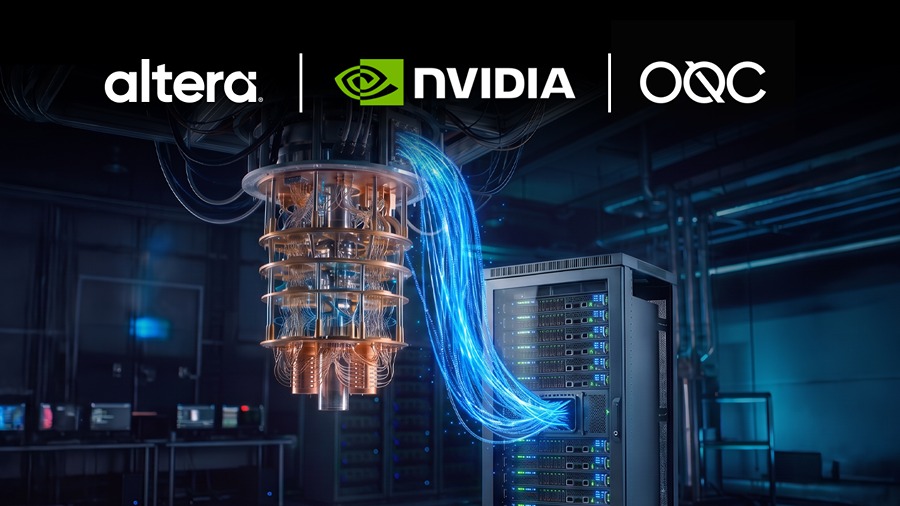
SAN JOSE, CA, Nov 24, 2026 – Altera is developing an FPGA-based quantum system controller reference design with OQC and NVIDIA. Built around the Agilex 9 Direct RF FPGA, the design provides control of a new-generation OQC quantum processing unit (QPU) through OQC-developed radio-frequency (RF) conditioning electronics and connects to NVIDIA accelerated computing over NVIDIA NVQLink.
The Agilex 9 Direct RF FPGA integrates analog-to-digital and digital-to-analog converters, allowing control and readout operations without external RF up-conversion or down-conversion hardware. The architecture also uses frequency multiplexing, allowing multiple readout channels to share a single RF port. According to Altera, this approach is designed to reduce the need for additional RF hardware as quantum systems expand to support more qubits.
“Our work with OQC and NVIDIA uses FPGAs to demonstrate a full system reference design in a real-world setting, from the quantum processor through the FPGA to the GPU,” said Farhad Shafai, head of business solutions & marketing at Altera. “This demonstration shows how Altera’s Direct RF technology can anchor the control layer of quantum systems, and it gives developers a clear path to build on.”
The reference design performs qubit control, resonator readout and spectroscopy within the FPGA. NVIDIA NVQLink connects the FPGA to GPUs, which handle processing-intensive tasks such as calibration and machine learning (ML)-based readout classification. NVIDIA CUDA functions drive the FPGA logic for QPU system functions.
“Advances in AI are opening new ways to build and operate quantum computers,” said Sam Stanwyck, director of quantum product at NVIDIA. “NVIDIA NVQLink gives quantum builders an open architecture to put those advances to work. Together with Altera and OQC, we’re giving developers a working reference design to explore AI-driven calibration and readout and accelerate the development of their own quantum systems.”
“Precise control and fast feedback are essential to unlocking the capabilities of our quantum processors,” said Simon Phillips, CPO at OQC. “Altera’s FPGA technology provides a programmable, low-latency connection to our QPU, bringing control and readout together while allowing us to refine calibration and feedback as our systems evolve. This integration helps simplify system development and provides a path to supporting more qubits.”
Source: Altera
About Altera

Altera is a semiconductor company founded in 1983 and based in San Jose, CA. The company designs programmable logic devices, including field-programmable gate arrays and complex programmable logic devices, along with related software tools. Engineers use these products to build configurable hardware for communications, computing, industrial, automotive and aerospace systems. Altera serves system designers, equipment manufacturers and technology companies that integrate programmable logic into network infrastructure, data centers and embedded applications. The company became part of Intel’s solutions business and later reestablished operations with majority investment from Silver Lake, while Intel retained a minority stake. Altera serves about 14,000 customers worldwide and employs approx. 3,000 people across North America, Europe and Asia. The company supplies chips and development tools that support flexible hardware design in electronic systems.
About NVIDIA

NVIDIA, founded in 1993 and headquartered in Santa Clara, CA, designs and manufactures graphics processing units, systems on chips, networking hardware, and AI intelligence software such as CUDA. Its products serve industries including gaming, data centers, autonomous vehicles, professional visualization, robotics, health care, and energy. The company introduced the GPU in 1999 and later expanded into accelerated computing and AI infrastructure. In gaming, its GPUs support high-performance rendering, while in AI and high-performance computing, its systems provide the infrastructure for training and deploying large-scale models. NVIDIA also develops tools for robotics and autonomous driving.
About OQC

OQC (Oxford Quantum Circuits) is a quantum computing company headquartered in Reading, England. Founded in 2017, the company emerged from research at the University of Oxford. It develops and operates quantum computers based on superconducting circuits for commercial and research applications. OQC provides access to its systems through cloud services and infrastructure deployments. Its customers include businesses, government agencies, research institutions and technology developers. The company serves industries including financial services, defense, pharmaceuticals, advanced materials and scientific research. Its quantum computing systems operate in data centers alongside conventional computing infrastructure. OQC has deployed systems in the United Kingdom, United States, Japan and Spain. It also works with technology companies on hardware development and system integration.
