

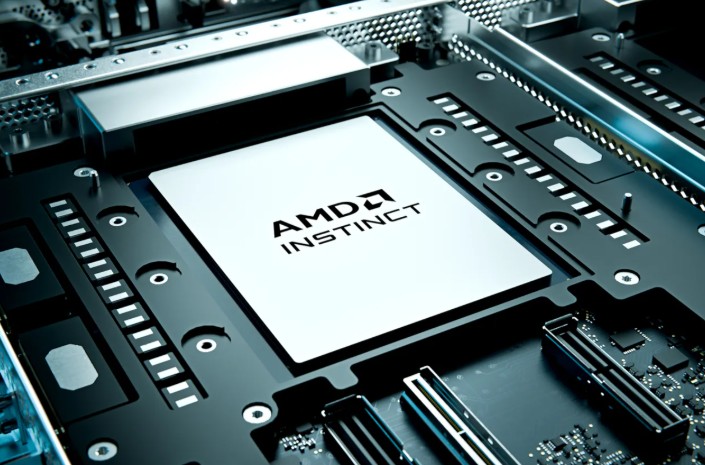
AMD is intensifying its push into the AI data center market, where Nvidia remains the dominant supplier. At its Advancing AI event in San Francisco, AMD presented an expanded hardware and software roadmap while highlighting deeper relationships with major customers, including Meta and OpenAI, reports Design News.
Meta plans to deploy as much as 6 gigawatts of AI infrastructure powered by AMD GPUs. Its collaboration with AMD already spans multiple generations of EPYC processors and Instinct GPUs. OpenAI is also working with AMD on data center infrastructure through a full-stack co-design strategy involving Instinct GPUs, Helios rack-scale systems, and EPYC CPUs.
Supporting these partnerships is AMD’s expanding AI product portfolio. The new Instinct MI400 series GPUs target AI inference and frontier-model training across hyperscale AI factories, sovereign AI installations, and scientific computing centers. AMD is emphasizing an open software ecosystem that includes programming models, compilers, libraries, runtimes, and deployment tools for AI and high-performance computing.
AMD also introduced Helios, a rack-scale AI platform designed for large-scale inference and agentic AI workloads. The system combines Instinct MI455X GPUs, EPYC Venice CPUs, and AMD’s open ROCm software.
The company is simultaneously expanding its EPYC processor family. New variants target agentic computing, enterprise servers, high-performance computing, technical workloads, and AI host nodes. The EPYC 9006 SP7, for example, provides up to 256 cores and 512 threads, while the EPYC 9006 LP is designed to keep accelerators supplied with data in dense AI racks.
Analysts see AMD’s growing customer base as evidence that hyperscalers want alternatives to Nvidia. Although Nvidia retains performance advantages in several areas, AMD is competitive in important specifications. Its Helios platform offers 50% more high-bandwidth memory than Nvidia’s comparable system and, on paper, 11% higher FP8 performance.
These gains suggest AMD is emerging as a stronger second source for companies seeking greater supply flexibility and less dependence on Nvidia.
