

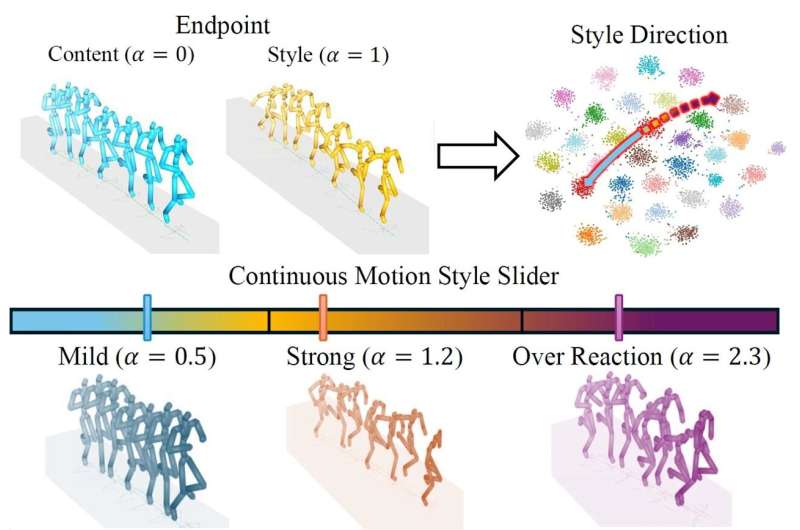
Animators often need a character to look happier, more tired, or less expressive without changing the underlying action. A research framework called Motion Style Slider addresses that problem by giving users continuous control over the intensity of AI-generated human movement, Tech Xplore reports.
Researchers from the Institute of Science Tokyo and Cygames developed the approach to overcome the fixed expressions offered by many motion-generation tools. Training systems on numerous intermediate performances would require additional motion-capture sessions, increasing production time and cost.
Motion Style Slider instead learns from two endpoints: a neutral movement and a stylized version of the same action. A numerical control adjusts the performance between those examples and can extend beyond the style to produce stronger expression. For instance, a walking motion can become progressively more joyful as the control increases.
The framework uses a diffusion model and a learned representation of motion style. It identifies a direction of change between the neutral and stylized examples, then combines that direction with the underlying motion and the selected intensity. This information guides a pretrained motion generator, allowing expressive variation without requiring recordings for every intermediate setting.
The researchers evaluated the method using benchmark datasets and additional captured examples designed to test expressions beyond those encountered during training. Comparisons with existing techniques examined control consistency, transitions, stronger stylization, and motion quality. The team reported favorable results for adjusting intensity smoothly and extending expression beyond the original examples.
A study involving 11 university participants found that viewers could distinguish changes in expressive intensity while perceived naturalness remained comparable. That small study offers encouraging evidence, although it does not establish performance across every production scenario.
Presented at ECCV 2026, the work could help game developers and filmmakers refine character performances. Its contribution is an adjustable creative control that better matches directors’ requests.
