

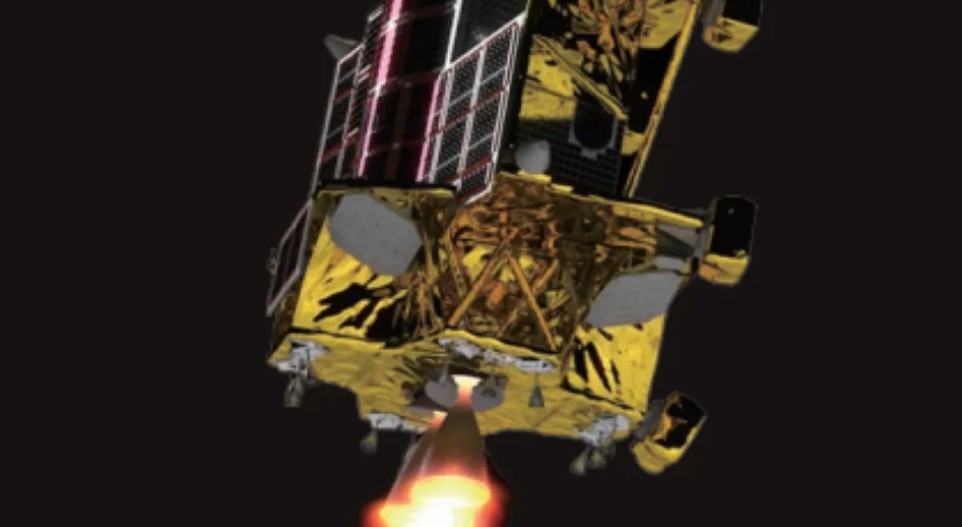
In The Engineer article, a Mitsubishi Electric engineer known as Tanaka-san describes an unconventional path into the space industry in a personal reflection centered on the SLIM Moon mission and the future of lunar exploration. Rather than beginning with a clear ambition to work in aerospace, he studied general engineering in Japan before discovering opportunities in satellite systems through a conversation during his job search. That moment eventually led him into spacecraft propulsion and systems engineering.
Tanaka-san began his career working on propulsion systems for satellites, contributing not only to technical design but also to procurement, manufacturing support, and fueling operations. His work frequently extended beyond office-based engineering into manufacturing facilities, testing environments, and launch-related activities. He explains that spacecraft engineering requires constant coordination across multiple teams and organizations because no mission is developed in isolation.
The article focuses heavily on his involvement in JAXA’s Smart Lander for Investigating Moon mission, known as SLIM. As a systems engineer, Tanaka-san helped ensure that the spacecraft’s many subsystems operated together reliably. Unlike previous lunar missions that targeted broad landing regions, SLIM aimed to demonstrate highly precise landing capability using a lightweight spacecraft. Achieving that level of accuracy is considered essential for future lunar infrastructure, scientific exploration, and long-term human activity on the Moon.
The mission also introduced innovations in propulsion and orbital planning. Instead of taking a direct route, the spacecraft used carefully calculated gravitational maneuvers to refine its trajectory over several months before attempting its landing. Weight reduction remained another critical engineering priority because every kilogram affects spacecraft performance and mission efficiency.
Now based in the United Kingdom at Mitsubishi Electric’s European Purchasing Centre, Tanaka-san works closely with international suppliers and partners, reflecting the increasingly global nature of space programs. He believes future missions, including lunar habitation and Martian exploration initiatives, will depend heavily on reliable landing technologies, resilient infrastructure, and collaborative engineering across nations.
