

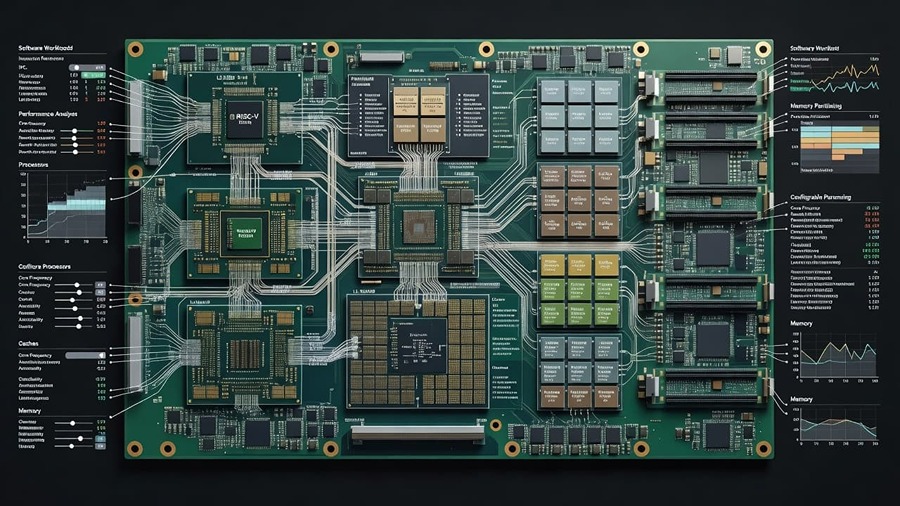
HSINCHU, Taiwan and SANTA CLARA, CA, July 29, 2026 – Andes Technology and Mirabilis Design have developed system-level architecture models for the Andes AX66 multicore and A45 RISC-V processors using the VisualSim platform. The models allow SoC architects to evaluate processor, cache, memory and interconnect configurations before RTL development.
Architecture Parameters
The models support multicore clusters connected through AMBA AXI-based interconnects, with options for coherent cache hierarchies. Architects can configure the models through processor parameters that cover:
- Number of cores per cluster and number of clusters
- Core configuration options
- Cache size, hierarchy levels, and coherency
- System address map and memory partitioning across multiple DRAMs
Users can change these settings without modifying the model implementation. This allows engineering teams to compare different system configurations using the same underlying models.
Software Trace Analysis
The VisualSim models support software traces and benchmarks, including workload distribution across multiple cores within a cluster. Architects can use these workloads to examine system-level performance and compare hardware configurations with software requirements before RTL integration.
The analysis covers processor topology, cache organization and memory structure during the architecture stage. Mirabilis Design said it validated the system-level models for both Andes processors.
“Early architectural decisions are critical to achieving SoC optimal performance and efficiency,” said Dr. Charlie Su, president and CTO, Andes Technology. “This collaboration enables our customers to evaluate Andes RISC-V processor configurations at the system level and finalize specifications with greater confidence before implementation.”
“System-level modeling allows SoC architects to explore processor, cache, and memory trade-offs using real software behavior,” said Deepak Shankar, founder, Mirabilis Design. “Our validated models of Andes AX66 and A45 processors support fast, parameter-driven exploration without requiring model rewrites.”
Availability
The Andes processor models are available through the VisualSim platform. Mirabilis Design plans to add support for additional Andes RISC-V IP and processor configurations over time.
Source: Andes Technology
About Andes Technology

Andes Technology is a supplier of high-performance, low-power 32- and 64-bit RISC-V CPU cores and related solutions for embedded systems. Founded in 2005, the company develops configurable processor IP cores used in applications such as AI, 5G communications, Internet of Things (IoT), storage, automotive electronics, and industrial control. Its portfolio includes RISC-V-based CPU cores, development tools, and software designed for energy-efficient, performance-optimized processors. Andes serves industries including consumer electronics, automotive, telecommunications, and industrial automation. Headquartered in Hsinchu Science Park, Taiwan, the company operates globally with a growing presence in Asia, North America, and Europe. Its customer base spans multiple regions, with Taiwan and the United States as key markets. The company continues to invest in R&D to advance processor technologies.
About Mirabilis Design

Mirabilis Design develops modeling and simulation software for electronic systems, semiconductors and embedded software. Founded in 2003, the company is headquartered in Santa Clara, CA. Its VisualSim software supports system architecture modeling, performance analysis, power estimation and design exploration. Products include VisualSim Architect, VisualSim Explorer, VisualSim Cloud and libraries of modeling components. Engineers use the software to analyze processors, memory, interconnects, networks, software workloads and embedded systems. Applications include semiconductor and chiplet design, AI infrastructure, automotive systems, aerospace, defense and communications. Customers include semiconductor companies, equipment manufacturers, engineering organizations, government agencies, research institutions and universities. Mirabilis reports that its software has supported more than 250 projects for over 55 customers. The company also works with academic institutions in North America, Europe and Asia.
