

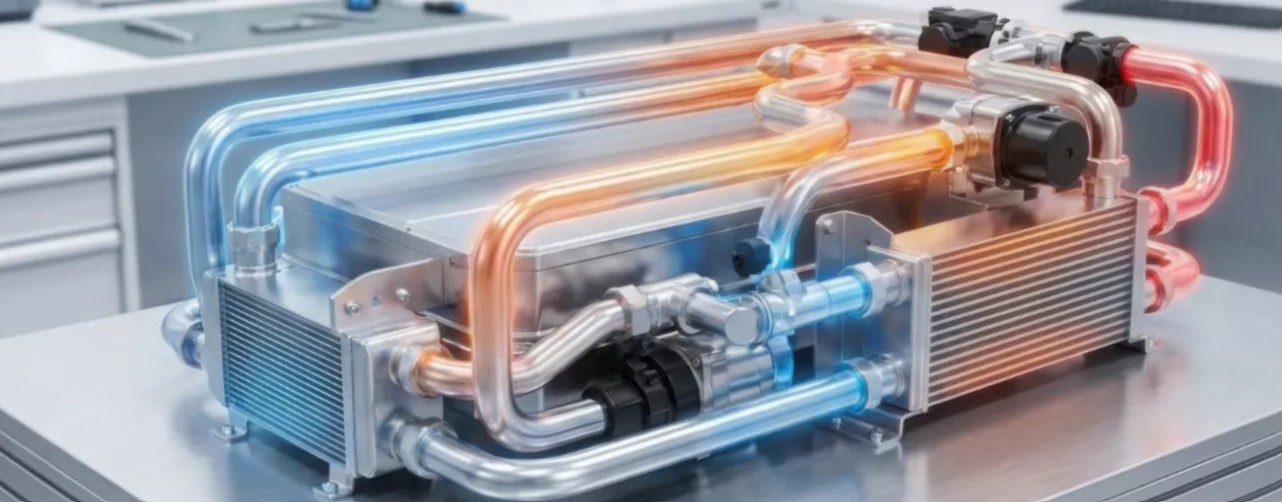
Thermal management is becoming increasingly complex across electronics, aerospace, energy, and industrial equipment. Ansys, part of Synopsys, emphasizes that effective thermal engineering depends on selecting the appropriate simulation strategy rather than relying exclusively on computationally intensive analysis.
Its approach combines Ansys Thermal Desktop and Ansys Fluent, allowing engineers to move from rapid system-level assessments to detailed computational fluid dynamics (CFD) simulations as designs mature.
Thermal Desktop supports early-stage analysis by integrating zero-dimensional and one-dimensional flow networks with two-dimensional and three-dimensional thermal modeling. It also handles radiation, two-phase flow, and parametric studies. Engineers can evaluate complex thermal systems without the computational expense of full-scale CFD.
Applications include heat exchangers, industrial cooling loops, and manufacturing processes involving rapid temperature changes. For example, combined flow and thermal models can evaluate two-phase heat exchanger performance in seconds rather than hours.
When detailed fluid flow and heat transfer behavior become critical, Fluent provides higher-fidelity analysis. Its capabilities include conduction, convection, radiation, multiphase flow, conjugate heat transfer, and chemical reactions. GPU acceleration further improves computational performance.
Fluent supports heat exchanger optimization by examining thermal interactions and pressure losses. In electronics cooling, engineers can analyze coolant paths, improve cold plate designs, and identify localized hotspots.
The software also supports battery thermal runaway analysis by simulating heat propagation, gas release, and mitigation strategies. For turbine applications, thermal results can be transferred into structural and fatigue simulations to assess component life.
The article emphasizes that simulation fidelity should match the engineering decision. Thermal Desktop provides rapid insights into complete systems, while Fluent resolves detailed flow-driven thermal behavior.
Combining both tools enables engineers to evaluate alternatives earlier, identify potential failures, reduce physical prototyping, and improve product reliability. This integrated strategy supports more efficient development without sacrificing the detailed analysis required for critical engineering decisions.
