

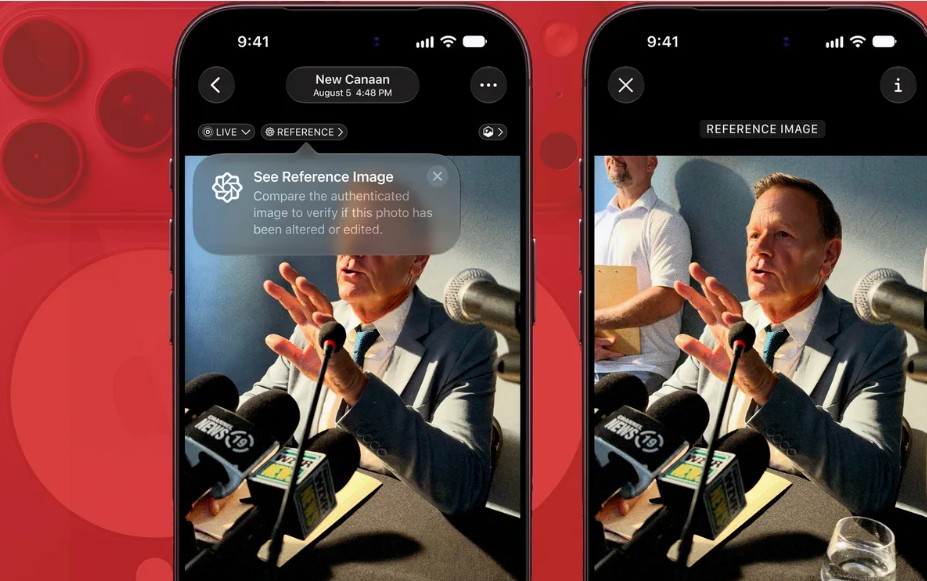
As generative AI makes realistic fake images easier to create, Apple is introducing a hardware-based approach to photo authentication. Apple Reference Image, available on the iPhone 18 Pro and Pro Max, captures and cryptographically signs raw sensor data before it leaves the camera sensor. The goal is to establish a trustworthy record of what the camera originally captured, tells IEEE Spectrum.
Reference Image works only with the phones’ 48-megapixel main camera because its security begins at the hardware level. Supported sensors are initialized at the factory with secure cryptographic keys. When Reference mode is activated, the sensor enters a secure environment, captures raw data and metadata, and signs them with its private key before conventional image processing occurs.
Because the raw sensor output is not immediately viewable, it is sent to Apple’s Private Cloud Compute infrastructure. Apple’s servers verify the secure key and use AI to determine whether the sensor data matches expected characteristics of an iPhone 18 Pro image. After verification, the system processes and re-signs the image before returning it.
The approach differs from the C2PA content-authentication standard supported by Adobe, Microsoft, Google, and major camera manufacturers. C2PA tracks an image’s provenance and editing history, but critics have identified vulnerabilities in establishing whether the original capture itself can be trusted. Apple attempts to strengthen this starting point by signing information inside the sensor.
Reference Image also uses Private Cloud Compute to limit disclosure of identifying device information. However, Apple’s tightly controlled implementation introduces other concerns. At launch, authenticated images can be viewed primarily through Apple platforms and apps, although a third-party API is available.
The technology does not eliminate deepfakes or authenticate video and audio. Instead, it provides another method for establishing photographic provenance. Its larger significance may be encouraging device manufacturers to treat media authenticity as a problem that begins with hardware, not simply with software after an image has already been created.
