

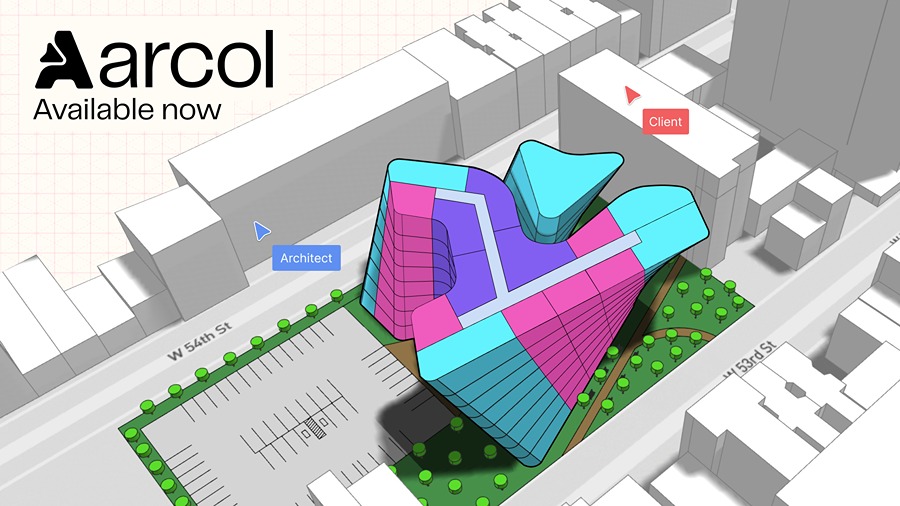
NEW YORK, NY, June 4, 2025 – Arcol has released a browser-based design platform aimed at improving how architecture, engineering, and construction (AEC) teams coordinate design work. The tool integrates real-time collaboration, intuitive modeling, and shared data in one environment. It is intended to address common workflow issues such as fragmented tools, file versioning problems, and manual data exports. By centralizing design and communication, the platform supports consistent project coordination and reduces the need for separate software solutions during the early and mid-stages of building design.
“We built Arcol to bring the magic back to building design,” said Paul O’Carroll, founder and CEO of Arcol. “I know from first-hand experience that architects and other building design professionals are too regularly bogged down by outdated software and tedious workflows. Arcol removes friction from the design process, so teams are empowered to collaborate freely, iterate quickly, and remain focused on creating their best possible work.”
“What stands out about Arcol is its ease of use and the way it reshapes our rhythm,” said Maria Eugenia Puppo, core activity product manager at slantis. “Arcol plugs into how we already work – quickly, visually and collectively – and lets us design not just faster, but also better, together.”
Arcol reflects the collaborative nature of the AEC industry and lets teams unlock their creative freedom by eliminating distractions from disconnected files and emails. Teams in Arcol:
- Collaborate and build simultaneously: Flow with colleagues in real-time and invite instant feedback with multiplayer access and commenting.
- Simplify the boldest designs: Easily create lofted, angled or even twisted buildings, detailed floor plans, and comprehensive site developments with geometric tools that simplify complex design tasks.
- Make confident, data-driven decisions: Ditch spreadsheets and manual calculations for automatic, real-time metrics.
- Create early alignment for long-term success: Use the industry’s most intuitive boards to share design views, data, and documentation in a single space and deliver design clarity from the start.
The Arcol experience embeds context into every interaction to simplify communication, and its boards feature is an apt example. Whether shaping a concept or gathering feedback, teams can drag and drop designs, data and documentation into a shared visual workspace and keep collaborators aligned as projects take shape.
Anton Shaw, BIM manager and automation lead at Warren & Mahoney, says “with Arcol, an entire team and client can work together in one tool to explore options and see the impacts in real time with updated reports at their fingertips.”
Arcol’s newly launched platform is positioned as an alternative to traditional BIM tools, with a focus on early-stage concept design. The company plans to expand its capabilities to support additional phases such as schematic design. Its development approach emphasizes collaboration, real-time interaction, and streamlined workflows in building design environments.
“We believe real-time collaboration is the future of our industry, “ said Bob Rayes, chief operating officer, Corgan. “Meaningful and impactful projects happen when all stakeholders are working in sync early and often. Arcol’s belief in re-thinking the AEC design stack with real-time collaboration and modern technology is something we’re incredibly excited to continue to partner with them on.”
Source: Arcol
About Arcol

Arcol is a U.S.-based technology company developing a browser-native design and documentation platform for the architecture, engineering, and construction (AEC) sector. Founded in 2021 and headquartered in Middletown, Delaware, the company focuses on improving building design workflows through real-time modeling, integrated project data, and collaborative tools. Its platform is used by architects, developers, contractors, and project stakeholders for tasks ranging from early-stage planning to construction documentation. Key functions include synchronized metrics, dynamic presentations, and in-context communication, all accessible without traditional software installation. Designed to reduce friction in design coordination, Arcol offers a streamlined alternative to legacy CAD and BIM tools. The company operates with a small team and has secured $5.1 million in venture funding to support its development and expansion. While revenue figures are not publicly available, Arcol continues to grow by targeting the need for simpler, more connected design environments in the AEC industry.
