

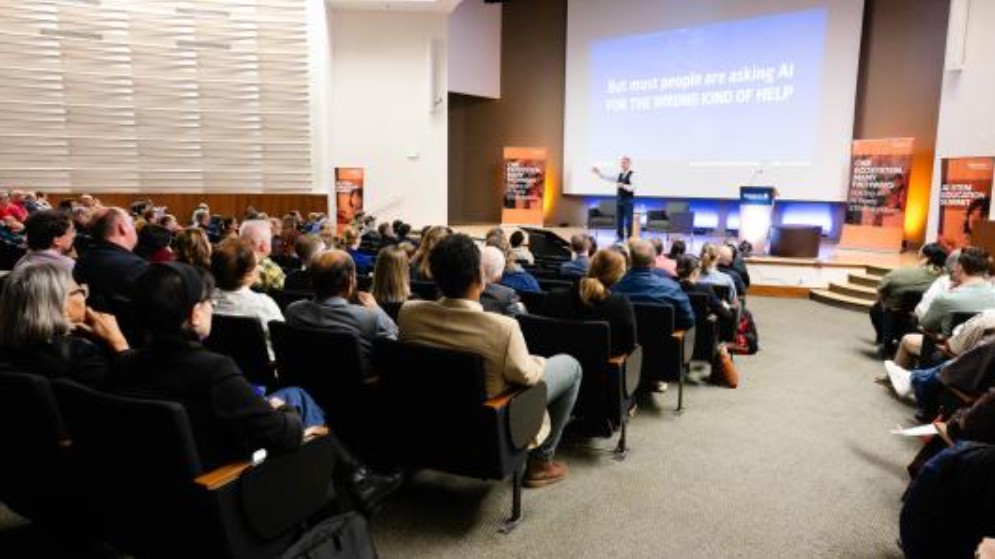
The U.S. Department of Energy’s Argonne National Laboratory brought together more than 160 educators, academic leaders, and STEM partners for its second annual AI STEM Education Summit on September 24, 2026. The event focused on preparing students for a future in which artificial intelligence (AI) plays an increasingly important role in scientific discovery, engineering, and education, says Argonne National Laboratory.
The summit, themed AI in Action, reflected a shift from understanding AI fundamentals to exploring its practical applications in classrooms and research laboratories. Participants examined ways to integrate AI into STEM education while preserving essential human capabilities, including creativity, curiosity, critical thinking, and decision-making.
Keynote speaker Dan Chuparkoff emphasized three human abilities that will remain valuable as AI advances: solving problems, making decisions, and imagining possibilities. He explained that AI can handle routine activities such as processing information, investigating topics, and communicating, allowing people to concentrate on higher-level thinking.
Argonne Deputy Director Sean Jones highlighted AI’s growing role in scientific research, including its contribution to more than 6,000 experiments involving chemicals for rechargeable energy storage. Purdue University’s Lucy Flesch discussed adapting university curricula and teaching methods to accommodate increasingly capable AI systems.
Participants also attended breakout sessions and toured Argonne’s autonomous laboratories, where AI, robotics, and human expertise work together to accelerate experimentation.
The discussions connected with the Department of Energy’s Genesis Mission, which brings together national laboratories, universities, and industry to accelerate scientific discovery through AI. The initiative emphasizes supporting scientists rather than replacing their expertise.
Argonne plans to continue collaborating with educators and STEM organizations through learning programs and knowledge-sharing activities. The objective is to prepare students who can effectively use AI while retaining the scientific reasoning, analytical judgment, and problem-solving abilities essential for future engineering and research careers.
