

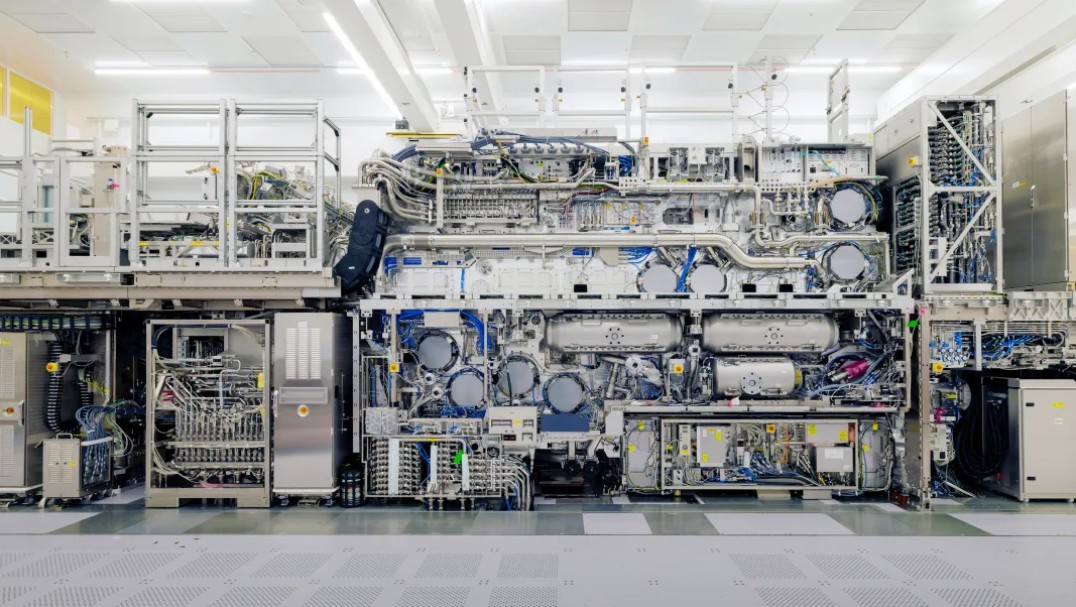
The semiconductor industry’s relentless drive toward smaller, faster, and more efficient chips has reached another milestone with ASML’s latest extreme-ultraviolet (EUV) lithography machine. Priced at approximately $400 million per unit, the new system can etch transistor features as small as eight nanometers, a significant improvement over the 13-nanometer resolution achieved by previous generations. The advancement allows chip manufacturers to continue increasing transistor density, a key factor behind improvements in computing performance and energy efficiency, tells the MIT Technology Review (full article available to subscribers).
The machine represents more than a decade of engineering development. At its core is a sophisticated EUV light source that generates extremely short-wavelength light by firing powerful lasers at microscopic droplets of molten tin. This process creates the precision needed to pattern intricate circuit features onto silicon wafers, enabling the production of increasingly advanced semiconductor devices.
ASML occupies a unique position within the semiconductor ecosystem. The Dutch company controls roughly 90% of the global market for advanced lithography tools, making its equipment indispensable to leading chip manufacturers. Alongside major foundries such as TSMC, ASML has become a critical pillar of the modern electronics industry. Without access to its lithography systems, manufacturers would struggle to produce the processors that power smartphones, cloud infrastructure, high-performance computing systems, and artificial intelligence applications.
Demand for the new machines is being fueled by the rapid expansion of AI. Training and deploying large language models requires increasingly powerful processors, prompting chipmakers to pursue more advanced manufacturing nodes. Access to ASML’s latest technology has therefore become a competitive necessity rather than a strategic advantage.
The development also carries geopolitical significance. Because ASML’s technology is essential to advanced semiconductor production, governments increasingly view the company as a strategic asset. Export controls, trade restrictions, and national efforts to secure semiconductor supply chains have placed lithography technology at the center of global technology policy.
As AI accelerates demand for computing power, ASML’s newest EUV system is expected to play a decisive role in determining the pace of semiconductor innovation. Its success will influence not only the future of chip manufacturing but also the broader technological landscape that depends on ever more capable processors.
