

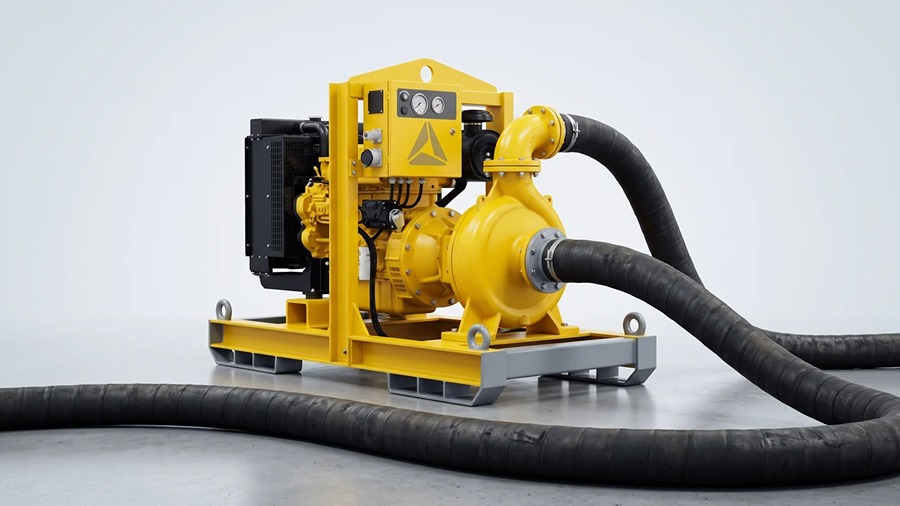
Atlas Copco’s Varisco division has deployed SimScale Physics AI to automate pump impeller design. Varisco reports that the workflow reduces design time from three to five weeks to days, with results within 5% of benchmarks across 10 pump configurations.
Varisco designs centrifugal pumps for drainage, dewatering and heavy liquid transfer. Previously, engineers built impeller geometry in CFTurbo, exported it to Ansys CFX and returned simulation results to the design team. Each iteration repeated that process. Ansys CFX license availability also limited how many variants engineers could evaluate simultaneously.
SimScale worked with Varisco to connect CAD tools, including CFTurbo and Onshape, with Physics AI and automation software.
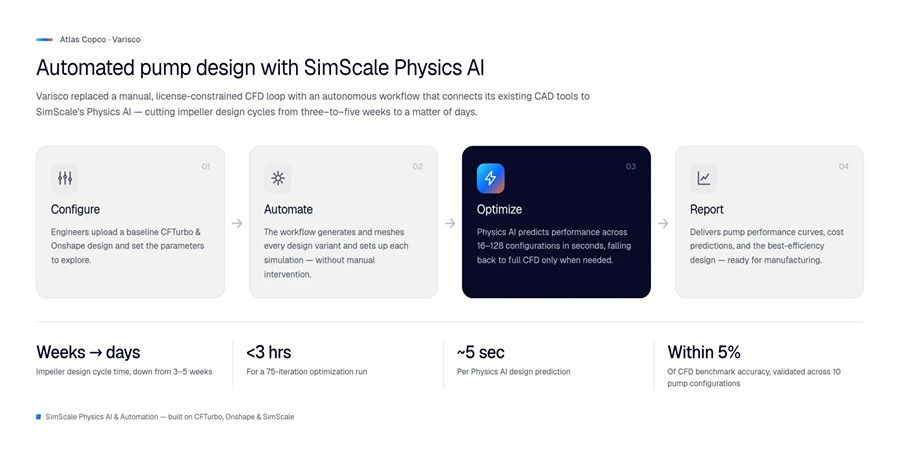
The resulting workflow has four stages:
- Configuration: Accepts baseline design files and parameters.
- CAD preparation and simulation setup: Generates and meshes design variants without manual intervention.
- Optimization: Runs Physics AI predictions across 16 to 128 configurations per suction diameter through a one-click module. It switches to full computational fluid dynamics (CFD) simulation when the AI model lacks training data.
- Reporting: Produces pump performance curves, cost predictions and design files for the best-efficiency configurations.
Giulio Ferrarese, R&D manager IFD, Varisco S.r.l., Atlas Copco said: “What SimScale’s team delivered for us was not a standard CAE tool — it was a solution built around how our engineers actually work. In the time it used to take us to complete one design iteration, we can now evaluate an entire design space and surface the optimal configuration. We’re already looking at how we extend this across our product lines.”
Alfred Saad, chief customer officer, SimScale added: “What Varisco has built is a template for how Physics AI reshapes industrial design practice. The bottleneck was never the engineer’s ability to generate ideas — it was the time it took simulation to keep pace with those ideas. Physics AI removes that constraint. Varisco can now explore design spaces their competitors cannot afford to explore.”
Varisco is expanding the model’s simulation training data to cover more design configurations. The next development phase will incorporate full volute geometry alongside impeller optimization and introduce net positive suction head (NPSH) analysis. Atlas Copco is exploring use of the workflow across pump product lines throughout the group.
Source: SimScale
About SimScale

SimScale develops cloud-based engineering simulation software. Founded in 2012, the company is headquartered in Munich, Germany. Its platform combines computational fluid dynamics (CFD), finite element analysis, thermal and electromagnetic simulation with Engineering AI agents and Physics AI models. Users upload CAD models, create projects, run analyses and review results through a web browser. The software can automate parts of simulation setup, meshing, solving and post-processing. SimScale serves engineers, designers, researchers and students in automotive, aerospace, architecture, construction, electronics, energy and industrial equipment fields. It offers individual, professional and enterprise subscriptions, plus a community plan for non-commercial public projects. The company also provides collaboration tools, documentation and technical support. SimScale reported more than 900,000 users in more than 190 countries in July 2026. That figure includes individual users, not confirmed customer organizations. SimScale employs more than 130 people from over 35 countries.
About Atlas Copco

Atlas Copco manufactures industrial equipment and provides maintenance, repair and rental services. Founded in 1873, the company has its headquarters in Sweden. Its products include air compressors, vacuum pumps, industrial tools, generators, light towers and water pumps. It also supplies air treatment systems, assembly equipment and inspection tools. Customers include automotive, semiconductor, aerospace, electronics, energy, construction and food processing businesses, along with research organizations. Its equipment supports manufacturing, assembly, quality checks, scientific research and food packaging. Atlas Copco organizes its operations into four business areas: Compressor Technique, Vacuum Technique, Industrial Technique and Power Technique. The group reported about 56,000 employees worldwide.
