

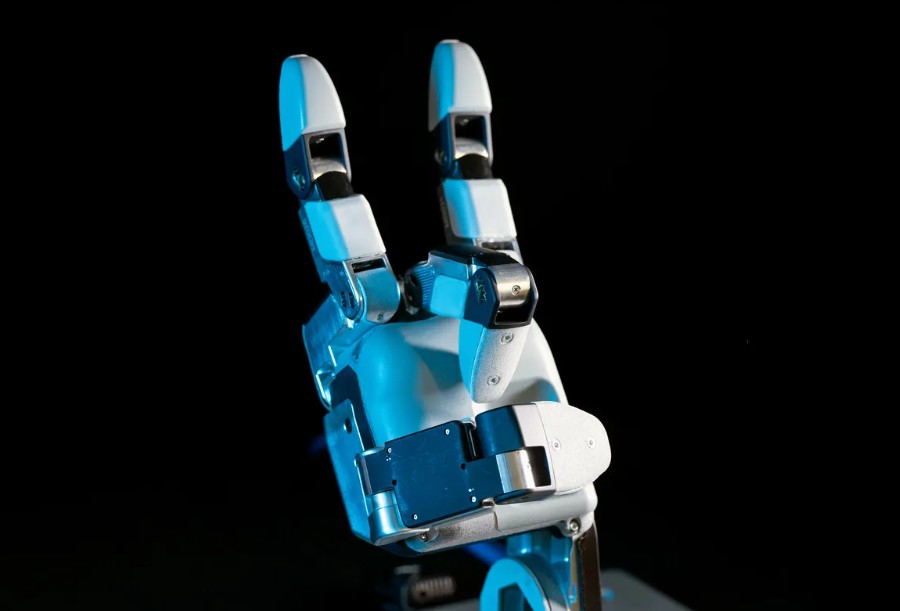
Boston Dynamics has redesigned the Atlas robot’s hand around a challenge that demonstrations can obscure: making dexterous hardware reliable, affordable, and practical to manufacture at scale. IEEE Spectrum reports that the new design prioritizes useful work over reproducing the appearance of a human hand.
The hand has three fingers and a thumb, with 13 degrees of freedom compared with 7 in its predecessor. Removing the little finger reduced complexity, while the movement gives Atlas more options for grasping objects and operating tools.
A key addition is the ability to spread the fingers apart. This lets fingers oppose one another and helps the robot hold a tool handle while activating its trigger, supporting tasks involving equipment such as drills or welding torches. Some movements exceed human capabilities, creating opportunities for reinforcement learning to discover effective manipulation strategies.
The redesign reflects a deliberate balance between flexibility and mechanical simplicity. Compared with more detailed robotic hands, fewer degrees of freedom allow larger, stronger actuators. These are integrated into the joints, with transmissions that allow external forces to drive them backward, helping the mechanism respond to contact.
Each actuator assembly can be replaced as a unit. Eliminating delicate tendons and cables crossing the joints removes components that can stretch or break, supporting repairability and consistent operation.
Boston Dynamics also wants the hand to be straightforward to simulate and sufficiently similar to human anatomy for demonstrations by people to support training. Those requirements connect design with the software methods used to teach manipulation.
The company is now examining the design details needed to manufacture 100,000 hands annually. That figure describes a production objective under consideration, not an achieved manufacturing rate.
For engineers, the article highlights the compromises involved in commercial robotics: dexterity must coexist with durability, serviceability, and production economics before humanoids can work reliably.
