

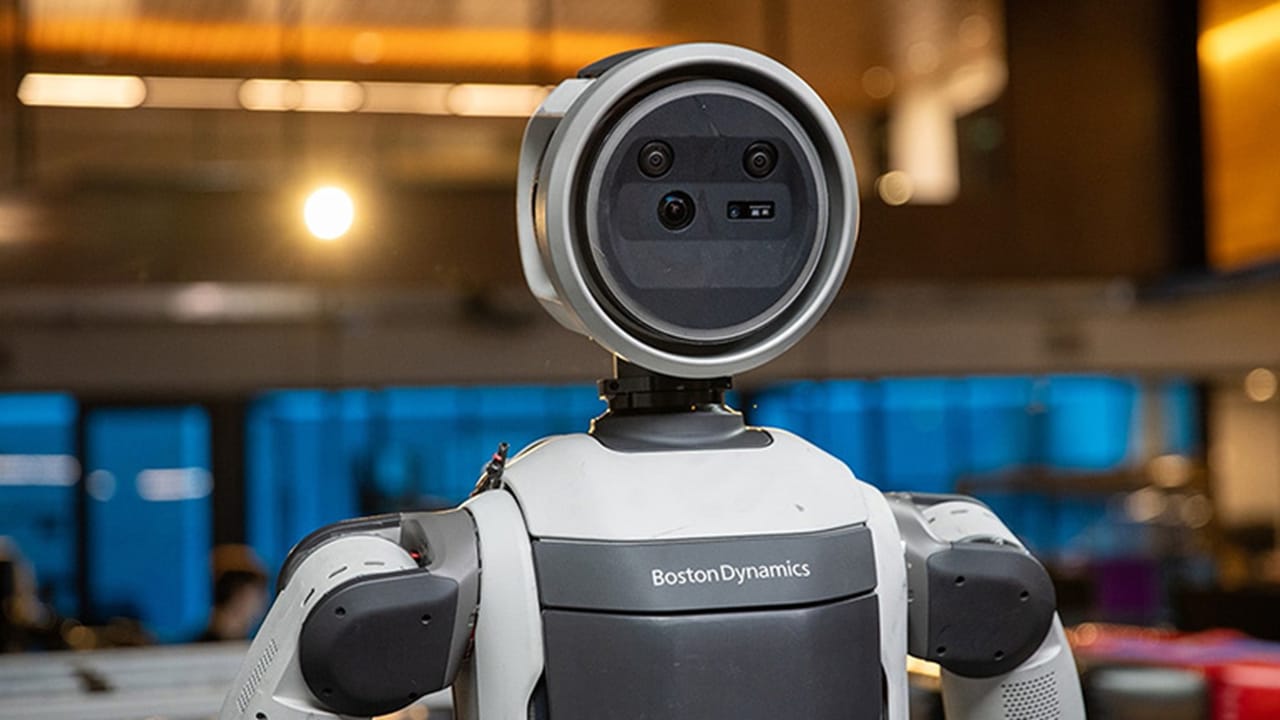
Boston Dynamics designed the head of its fully electric Atlas humanoid robot around the demands of industrial environments rather than human appearance. The result combines perception, communication, and computing in a distinctive non-human form intended to help Atlas operate safely alongside workers in factories and warehouses, tells Design News.
Taylor Frey-Baker, a mechanical engineer on the Atlas Head team, explains that the robot was deliberately designed to look like industrial equipment. Instead of a humanlike face, its head uses circular light rings at the front and rear to communicate operational status and intent. These lights can change color or blink in different patterns, giving nearby workers an immediate indication of what Atlas is doing or whether the system requires attention.
Head movement provides another visual cue. Atlas can rotate and tilt its head, allowing people to recognize where its sensors are focused. Because the head is a natural point of attention, its orientation helps workers understand what the robot is observing or preparing to do. This can reduce uncertainty when humans and robots share a workspace.
Perception is handled by HDR stereo cameras mounted in the head. Their high resolution supports remote operation, while high dynamic range improves visibility when lighting conditions vary dramatically. For example, an operator can see into a dark compartment even when it is positioned against a bright window, avoiding the washed-out imagery that conventional cameras might produce.
The elevated stereo vision system also gives Atlas the spatial awareness required to detect unexpected obstacles and execute complex industrial tasks. Meanwhile, lights, audio feedback, and head orientation communicate information back to people.
The design illustrates an important direction for industrial humanoids. A robot head does not need to imitate a person to communicate effectively. Instead, perception hardware and carefully designed visual signals can make a machine’s behavior easier for nearby workers to interpret, improving safety and predictability in human–robot environments.
