

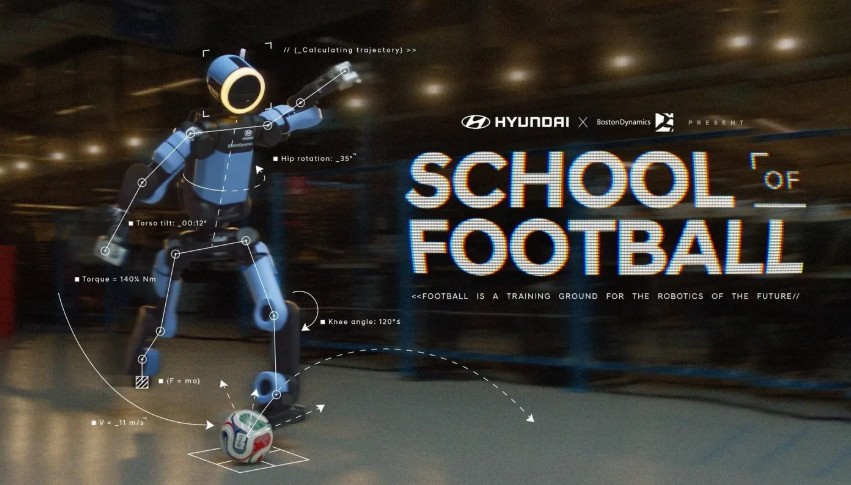
Boston Dynamics has taken a major step toward making humanoid robots practical for industry with the latest version of Atlas. While the robot continues to impress with agile movements such as kicking a soccer ball, the biggest breakthrough is hidden beneath its exterior. The company has redesigned Atlas to be almost an order of magnitude simpler than earlier versions, dramatically reducing the number of components and unique parts. This streamlined design is expected to make the robot easier and faster to manufacture, more reliable, and significantly less expensive, tells Forbes.com.
The simplified architecture is more than an engineering achievement. It represents Boston Dynamics’ shift from developing advanced research robots to building machines that can be manufactured at scale. Fewer parts reduce assembly time and maintenance requirements while improving durability, making Atlas better suited for demanding industrial environments. According to the company, these improvements are essential for turning humanoid robots into commercially viable products rather than specialized demonstrations.
Hyundai, Boston Dynamics’ parent company, plans to support this transition with large-scale manufacturing. The company has outlined plans for production capacity of up to 30,000 Atlas robots annually, positioning the robot for widespread use in factories and warehouses. Initial deployments are expected to focus on material handling, parts sequencing, and other repetitive industrial tasks where flexibility offers advantages over fixed automation.
The article also highlights that the robot’s athletic demonstrations are only a small part of the story. Skills such as soccer kicks showcase balance, coordination, and dynamic motion, but the underlying engineering advances are what will determine Atlas’ commercial success. By simplifying hardware without sacrificing capability, Boston Dynamics aims to improve manufacturing efficiency and lower ownership costs while enabling reliable operation in real-world workplaces. If the strategy succeeds, Atlas could help accelerate the adoption of humanoid robots across manufacturing, logistics, and other industries that require adaptable automation.
