

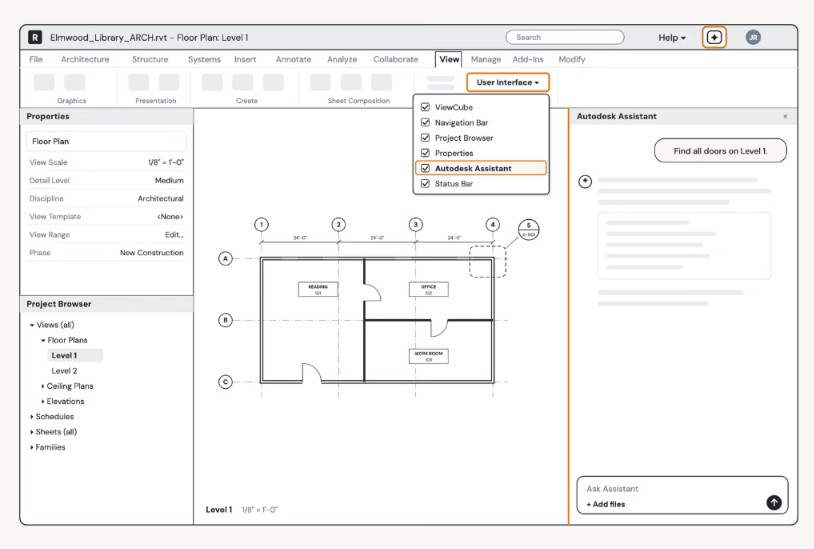
Autodesk Assistant, introduced in Revit 2027, brings conversational AI directly into building information modeling (BIM) workflows. The integrated chat panel allows architects, engineers, and BIM managers to retrieve information, query models, and perform design tasks using natural-language instructions, tells Pirros.
The assistant supports three primary functions: answering questions using Autodesk documentation, retrieving information from the active model, and executing model changes. Users can create floor plans, generate schedules, modify views, and manage documentation without navigating multiple commands. It also processes attached PDFs, spreadsheets, images, and Word documents for additional context.
Since its April 2026 introduction, Autodesk has expanded the assistant’s capabilities. Recent updates include graphical overrides, schedule modifications, improved tagging, and Dynamo graph creation through the DynamoMCP technology preview. Users can also save frequently used prompts and receive suggestions based on their workflows.
However, Autodesk Assistant has limitations. It operates within a single open model, lacks access to companywide project knowledge, and stores prompts under individual Autodesk accounts. Its availability is restricted to Revit 2027 and later, while automated changes require careful verification.
The article compares these capabilities with Pirros’s AI agent, Mira, which supports Revit 2025, 2026, and 2027. Designed for repetitive production tasks, Mira can renumber details, audit views against company standards, modify text notes, update parameters, and reposition room tags.
Unlike Autodesk Assistant, Mira can access approved details and families through Pirros’s Quality Management System. Its shared skills help organizations standardize workflows, while preview and approval mechanisms allow users to review changes before execution.
The article also discusses Model Context Protocol (MCP), which connects Revit with external AI applications, including Claude and Cursor.
Together, these developments demonstrate AI’s growing role in architectural design and documentation. Autodesk Assistant addresses everyday modeling tasks, while specialized agents offer broader automation, consistency, and organizational knowledge across complex BIM projects.
