

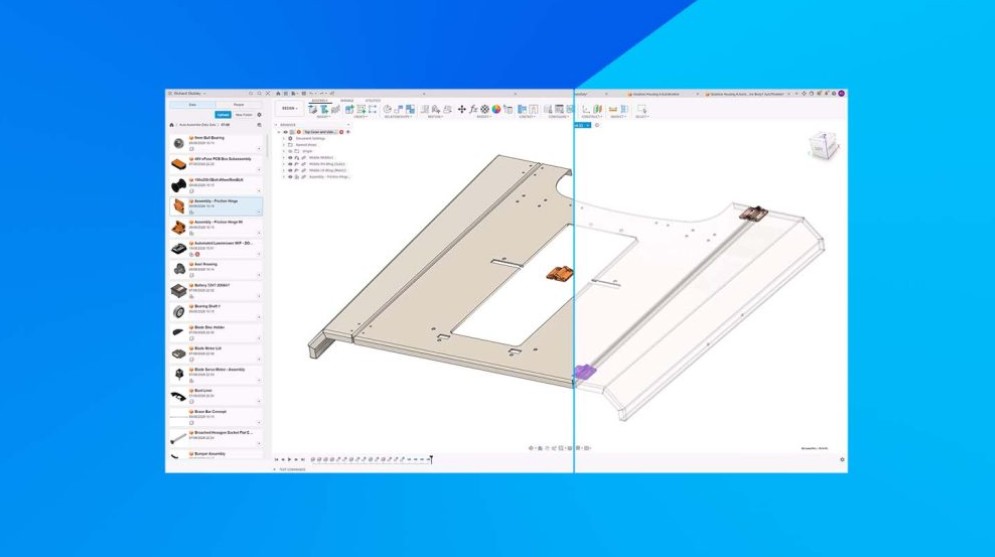
Autodesk is expanding artificial intelligence across Fusion and Inventor, aiming to automate repetitive engineering work while connecting design, manufacturing, and product data more closely. Announced around Autodesk University 2026, the new capabilities build on existing Fusion AI tools such as AutoConstrain, tells Develop 3D.
A key addition is AutoTimeline, which converts imported geometry into editable parametric parts. This could reduce the work required to reconstruct imported models before engineers can modify them. AutoAssemble takes automation further by bringing individual parts together into assemblies. Combined with Autodesk Assistant-powered configurations, the tools target repetitive modeling, assembly, and product-configuration tasks.
Autodesk is also extending automation into manufacturing. System Modeler enables teams to automate machine setup, toolpath generation, and production preparation. Instead of repeating these processes for each job, manufacturers can create reusable automations designed to shorten the path from engineering to production.
Another significant development is Inventor becoming Autodesk’s first Fusion Connected Client. The connection links Inventor’s desktop engineering environment with Fusion’s cloud-based data and processes, giving teams a more continuous workflow across the product lifecycle.
Autodesk Assistant is also gaining deeper access to Inventor. By working with Inventor APIs and its iLogic foundation, the AI assistant can analyze models, change parameters and components, create model states, and automate routine tasks. In Vault, Autodesk Assistant uses natural-language search to locate existing design data and suggest relevant parts, encouraging engineers to reuse proven work rather than recreate it.
Autodesk is also developing agentic product lifecycle management, integrated task management, design reuse, and a more open Fusion platform. Together, these developments point toward an engineering environment where AI connects design decisions, product information, manufacturing processes, and enterprise systems while reducing manual work and rework.
