

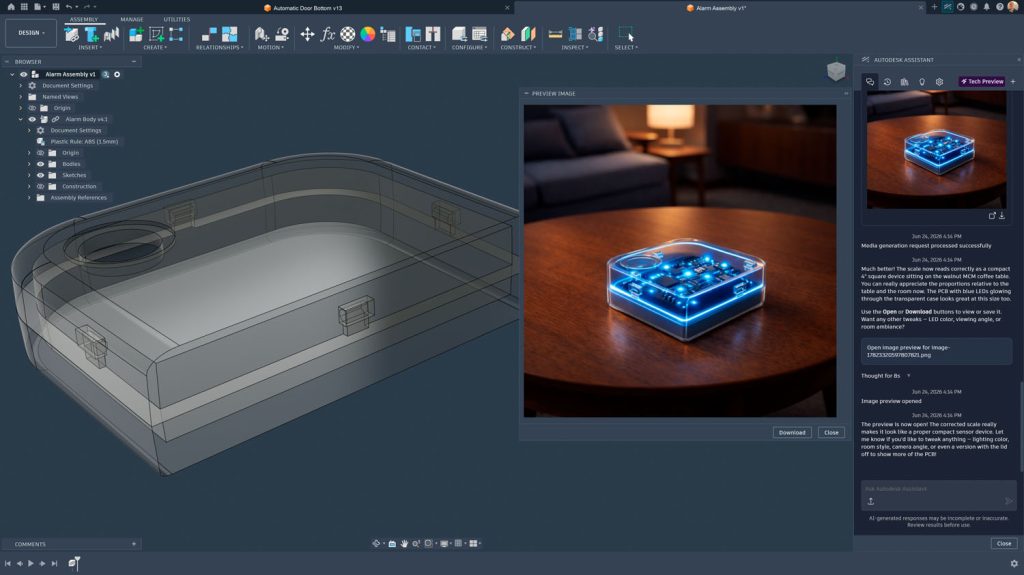
Autodesk is developing an AI strategy that extends beyond adding assistants to conventional CAD software. Its vision combines geometry-aware foundation models with project intelligence, a persistent layer of data, decisions, and engineering knowledge that follows a product throughout its lifecycle, tells Develop 3D.
CEO Andrew Anagnost argues that engineering knowledge is often lost as projects move between people, applications, and development stages. CAD geometry records what engineers designed but may not capture why they changed a tolerance or which manufacturing constraint influenced a component. Project intelligence aims to preserve this context so AI systems can retrieve and reason over it during future work.
Neural CAD provides the geometry-focused part of the strategy. Rather than using a large language model simply to issue commands to existing CAD tools, Autodesk is training foundation models on professional CAD data so they can reason directly about geometry, topology, and engineering relationships. The technology can generate editable boundary representation geometry from text, sketches, images, and voice inputs.
Autodesk sees Neural CAD as complementary to parametric modeling. Neural CAD can accelerate conceptual exploration and generate multiple alternatives, while deterministic CAD tools provide the precision and control required for engineering. Autodesk acknowledges that Neural CAD cannot yet guarantee perfect accuracy, making human oversight and conventional CAD engines important for healing, constraining, and refining generated geometry.
The strategy also raises questions about data ownership and platform dependency. Project intelligence could eventually contain not just CAD models but company design rules, workflows, objectives, and accumulated engineering expertise. Storing this information within a vendor-managed system could create deeper dependence than proprietary file formats.
Autodesk is addressing concerns through benchmarking, anti-parroting research, transparency measures, and data controls. Still, customers must weigh privacy, intellectual property, and additional AI costs. Ultimately, Autodesk’s vision positions AI as a layer connecting geometry, design intent, and organizational knowledge rather than simply automating CAD commands.
