

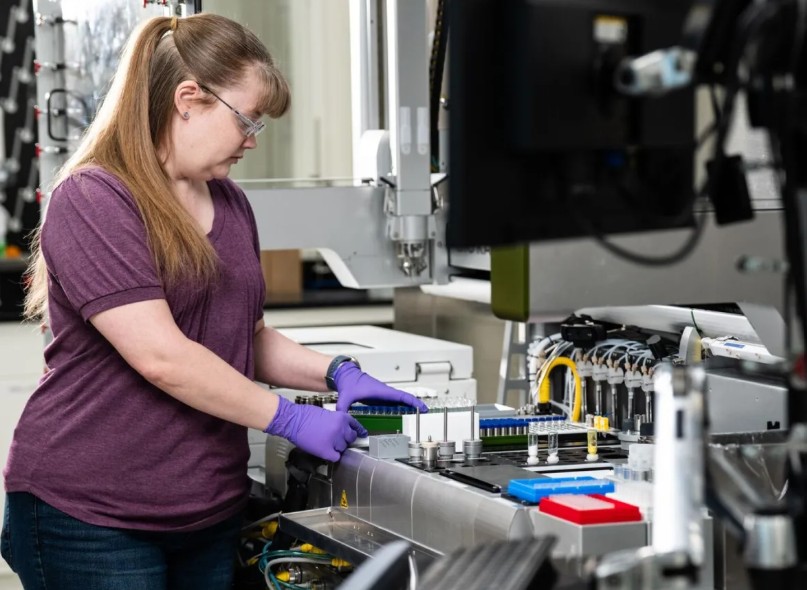
Researchers at Pacific Northwest National Laboratory have developed AutoLabs, a generative agentic AI system designed to simplify the programming of autonomous laboratory robots. The technology translates scientists’ experimental goals into instructions that robots can execute, reducing a process that can otherwise require weeks of collaboration between scientists and automation engineers, tells this Tech Briefs article.
AutoLabs currently works with Big Kahuna, an automated platform from Unchained Labs used by PNNL researchers to investigate battery materials. Scientists can describe experiments in everyday language rather than learning the robot’s programming and hardware requirements. AutoLabs identifies missing information, asks clarifying questions, performs calculations, and determines whether the proposed experiment is physically achievable.
The system can manage eight to 50 experimental conditions simultaneously. It calculates chemical quantities, selects heating and stirring settings, recommends dispensing methods, and converts the finalized design into hardware instructions. Big Kahuna can then perform multistep workflows involving mixing, heating, stirring, and filtering. According to the researchers, automation could enable 5–10 times more experiments than manual methods.
Developing AutoLabs presented several engineering challenges. Researchers had to translate ambiguous natural-language requests into precise procedures while capturing practical knowledge that experienced automation engineers often acquire over years but never formally document. Proprietary laboratory equipment also complicates integration because manufacturers may not provide complete programming interfaces or APIs.
PNNL researchers are now developing memory capabilities that could store experimental conditions, chemicals, and lessons from previous work. Future versions could use this information to improve experiment design and avoid repeating mistakes.
The team also plans to add literature searches, hypothesis generation, results analysis, and next-experiment design. AutoLabs is not intended to replace scientists or systems engineers. Instead, it automates repetitive translation between scientific ideas and executable procedures, giving researchers more time for creative and analytical work.
